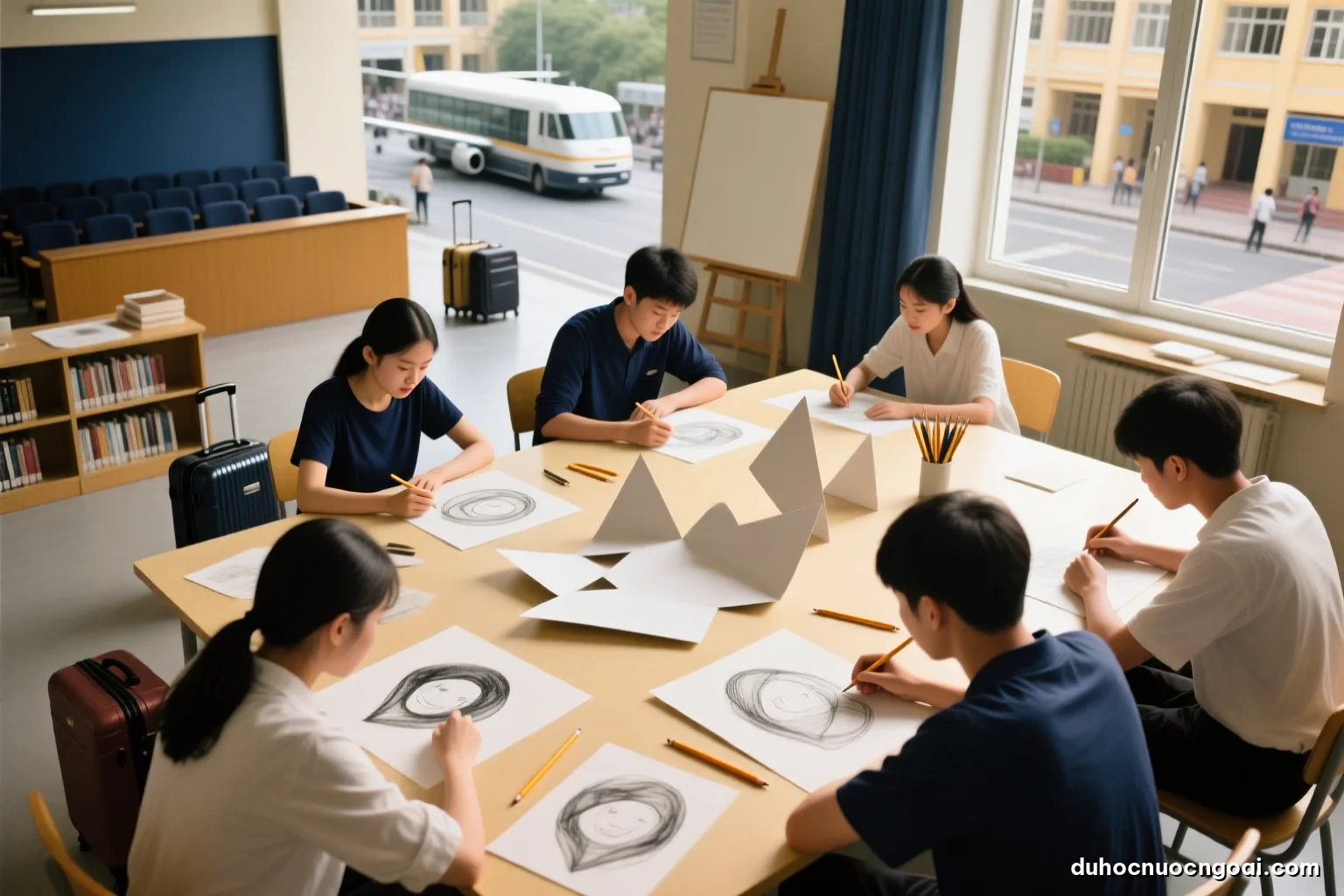
A study abroad portfolio is a selected body of work demonstrating your ability to observe, your visual thinking and your creative process, submitted with your application to programmes in design, architecture, fine art, fashion, animation and photography, and sometimes also media and games. Most universities accept a digital version, usually around 10 to 20 pieces or a few dozen pages, depending on the university and level; for creative subjects the portfolio usually carries more weight than your school grades.
Committees are not looking for perfect, professional-standard work. They look for signs of someone who knows how to look, try, fail and correct — which is why sketches, trial models and process notes are often as important as finished pieces. This article covers what committees look at, how to choose and arrange your work, differences between subjects and a realistic preparation timeline.
What committees look at in a portfolio
Observation and foundation skills. Drawing from life — people, objects, spaces — shows you look carefully and can render proportion, light and materials. Even for digital design, many universities still want to see a few pages of hand drawing from direct observation, not copied from photographs.
Ideas and how you develop them. A project that goes from an initial question, through several trial options, to a result with reasons. Committees want to know why you chose this direction and which ones you abandoned.
Process. Sketchbooks, drafts, trial models, photographs of the stages. This is where Vietnamese students fall short most often: submitting only beautiful finished products with no trace of thinking.
Controlled variety. Trying many materials and media shows curiosity, but there needs to be a common thread so the viewer recognises your voice.
Personality. Work that grows out of something you genuinely care about — your neighbourhood, your family, an environmental issue — is usually more memorable than exam-practice pieces done to a template. Drawings done to the exam-prep templates for Vietnam's V and H entrance blocks can be included to show skills, but should not make up most of the portfolio.
How portfolios differ by subject
Each subject emphasises a particular ability. The table below gives general suggestions for direction; specific requirements always follow the university's admissions page.
| Subject | What to include | What is often missing |
|---|---|---|
| Architecture | Hand drawings of space, perspectives, physical models, purposeful photographs of spaces, a small project solving a problem of a particular place | Real models; over-reliance on 3D modelling software |
| Graphic design, visual communication | Projects with a brief, research, sketches, options and final products; typography, layout, identity systems | Process; only products made from online templates |
| Product, industrial design | Idea sketches, trial models, material experiments, users and problems | Design reasoning; testing with real users |
| Fashion | Research of inspiration, sketches, material trials, real sewn samples if possible, a small collection with a story | Real fabric and sewing; only illustrations |
| Fine art | Mixed-media work, observational drawing, series of works on a theme, sketchbooks | Depth of theme; notes on your thinking |
| Animation, games, film | Character and movement drawing, storyboards, short films or a showreel, environment design | Storytelling; drawing characters from observation instead of copying existing styles |
Music, theatre and dance usually do not use portfolios but recordings or auditions — an entirely different process with its own calendar. If you are torn between two related subjects, such as interior design and architecture, read each subject's portfolio requirements carefully: they may differ enough to need two separate versions.
Choosing and arranging your work
Start by gathering everything you have made in recent years, photographing or scanning it at high quality, then choosing a large set of about twice the number the university requires. From there, filter by three criteria: which pieces show your foundation skills most clearly, which projects have a complete process, and which pieces say the most about you. Work more than two or three years old should usually be dropped, unless it is the starting point of a line of development you want to show.
Arranging by project rather than by medium is usually easier to read: each project takes a few pages, going from idea and research through sketches to the product. The first and last pages are what viewers remember most, so put your strongest project there. Each piece needs a short caption: title, medium, size, year, and one or two sentences about the intention or context. Write captions like a practitioner, not like an advertisement.
Technically, photographs of your work must be well lit, colour-accurate, flat, not tilted and with no stray objects in the frame. A good piece photographed badly looks like a bad piece. File formats, file size, number of pages and submission portals differ by university; some use their own online portfolio platform, others require a PDF through the applicant portal.
A 12-month portfolio preparation timeline
A portfolio with a real process takes time. The framework below is for a grade 11 student preparing to apply for a bachelor's degree:
- Months 1–2: read the portfolio requirements of the universities on your list, noting the number of pieces, format and special requirements such as observational drawing or a sketchbook. Gather and photograph your earlier work.
- Months 3–5: practise observational drawing regularly; start one or two new projects that grow out of something you care about, documenting the process from the start.
- Months 6–8: the summer is a good time for a major project or a summer course in a creative field; keep documenting and photographing your process.
- Months 9–10: select, arrange and write captions; ask an art teacher or a practitioner for feedback. Many universities hold online portfolio reviews for international applicants — take advantage of them if available.
- Months 11–12: rephotograph pieces that are not yet good enough, finalise the digital version, check format and file size for each university, and submit before the deadline.
Students who start late can still make a portfolio in a few months, but should choose fewer projects and document the process thoroughly rather than trying to reach the number with rushed work. Some universities have a one-year art foundation programme for those who need more time to build a portfolio before starting a bachelor's.
Portfolio interviews and the accompanying essay
Many art, design and architecture schools invite applicants to an interview after the application round, usually online for international applicants. You will be asked about one or two pieces: where the idea came from, why you chose this material, what you would change if you did it again, which artists or designers have influenced you. The best preparation is to practise talking about your own work in English, briefly and specifically, and to prepare one or two pieces not in the portfolio to share if asked.
The essay for creative subjects also has its own focus: committees want to see that you think of design and art as a way of seeing the world, not just a hobby of drawing nicely. Mentioning a work, a building or an exhibition you have seen and what it suggested to you usually carries more weight than "I have loved drawing since I was little". The portfolio and the essay should complement each other: the essay explains what the portfolio shows. If a project in your portfolio is central to your essay, make sure the reader can find it easily, for example by placing it in the first pages and using the same title in both places.
Portfolio, school record and language: which part decides
For creative subjects the portfolio is usually the heaviest part, but not the only one. Specialist art and design schools may admit students with average grades if their portfolio is outstanding; architecture or design faculties within a comprehensive university usually consider both, and architecture in many places has additional conditions in mathematics or physics because the programme includes structures and engineering. Language is still an entry condition: a good portfolio cannot replace the university's or the visa's English threshold, although some art schools set lower thresholds than academic subjects.
So a student who wants to study a creative subject should divide their time according to the priorities of their list of universities. If you are aiming at specialist art schools, put your effort into the portfolio and keep your language at a sufficient level. If you are aiming at the architecture faculty of a research university, you need both science grades and a portfolio, so you must start earlier. A useful habit is to make a table as with other application components: for each university, note the portfolio, academic and language requirements and any weighting the university publishes, then allocate your time accordingly.
Mistakes that get portfolios marked down
The mistakes below are common in creative applications:
- Copying or redrawing other people's photographs or paintings without saying so, or using copyrighted images, fonts or assets as if they were your own. Committees recognise familiar styles very quickly; this is an integrity breach.
- Using AI image generation tools without saying so, when the university requires work made by the applicant. Many universities now have their own policies — read them before using such tools.
- Too many pieces of the same kind, for example all portraits done to exam-practice templates.
- No process: only final products, no sketches, no experiments.
- Photographs of work that are blurry, colour-shifted, shadowed or on a cluttered background.
- Not following the requirements: too many or too few pieces, the wrong format, forgetting a compulsory part such as observational drawing.
- A portfolio made by someone else or over-edited by others — at interview, the gap between the work and the way you talk about it shows immediately.
Frequently asked questions
How many pieces does a study abroad portfolio need?
It depends on the university and subject; many ask for about 10 to 20 pieces or a few dozen digital pages. Always follow the number on each university's admissions page, even if you have more good work — exceeding the requirement usually earns no extra credit.
Can I make a portfolio without formal drawing training?
Yes, especially for design and architecture at the many universities that care more about thinking than perfect technique. You need to start early, practise observational drawing and document your process. Summer courses or an art foundation programme help those who start late.
Does an architecture portfolio need hand drawing?
Most universities want to see hand drawing, especially spatial sketches and observational drawing, along with physical models. Computer renderings are accepted but should not make up the whole portfolio, because committees want to see your ability to think by hand and in real space.
Can I use exam-practice drawings from Vietnam's V and H blocks in my portfolio?
You can use some to demonstrate foundation skills such as figure drawing and colour composition. But if they make up most of the portfolio, it will lack personality and process. Combine them with projects you have developed from your own interests.
How does a master's portfolio differ from a bachelor's portfolio?
A master's portfolio usually includes university projects and professional projects, emphasising depth of expertise, a professional working process and a direction of development. Committees expect to see a clear orientation that matches the programme's direction.
Should I ask a practitioner for feedback on my portfolio?
Yes. Feedback from an art teacher, architect or designer helps you select and arrange better. Many universities also hold portfolio reviews for applicants. Just keep to the principle: feedback, not doing it for you.