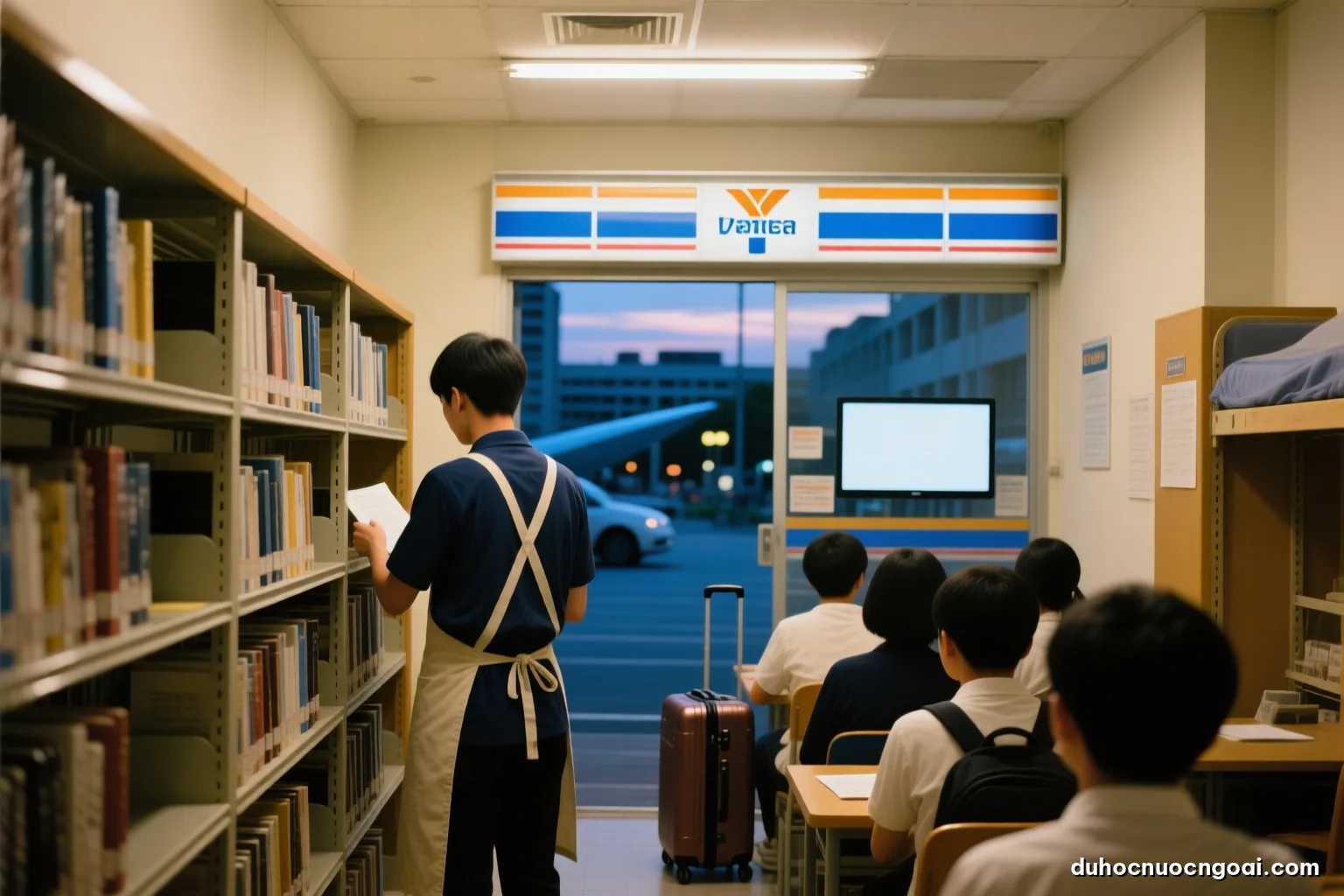
A Japanese language school is an institution teaching Japanese to foreigners, admitting international students under the "Student" status of residence for a course of up to about two years, with intakes in April, July, October or January depending on the school. Choosing the right school means choosing on three things: your goal after language study (a senmon gakko, university or graduate school), the school's quality and legal status, and a city that suits your budget.
Most Vietnamese students begin their journey in Japan at a Japanese language school, so this decision affects your first two years and your chances of further study. From April 2024, Japan has applied a new law on accrediting Japanese language education institutions, which makes checking a school's status even more important. This article explains how Japanese language schools work, the types of course, how to check a school and the questions to ask before applying.
How Japanese language schools work and what students study
A long-term course at a Japanese language school usually lasts from one year and six months to two years, depending on the intake. Students starting in April usually study for two years and those starting in October for a year and a half, so that both finish in March, in time for the Japanese system's exam and enrolment season. Each day has about four class periods, in the morning or afternoon, five days a week. Classes are grouped by level through a placement test at the start of the course.
Content runs from beginner to upper intermediate and advanced: grammar, vocabulary, kanji, listening, reading, paragraph writing and conversation. Many schools offer JLPT preparation, EJU preparation (Japanese, mathematics, and science or Japan and the World), essay writing and interview practice for senmon gakko and university entrance. Schools focused on university entry usually devote the final semester entirely to admission applications.
An important point is that attendance is monitored very closely. Low attendance directly affects the renewal of your status of residence, because the immigration authorities consider study to be a student's main activity. Many schools set internal attendance thresholds and meet individually with students whose attendance drops.
The 2024 law on accrediting Japanese language institutions: what it means for you
Previously, Japanese language schools admitting international students had to be on a list published by Japan's Ministry of Justice. From 1 April 2024, a new law on ensuring the quality of Japanese language education at accredited institutions came into force. Under it, the Ministry of Education, Culture, Sports, Science and Technology (MEXT) accredits institutions that meet standards for curriculum, teachers, facilities and student management; teachers there will gradually need the national "registered Japanese language teacher" qualification.
The law has a transition period of several years: schools on the old list can still admit international students during this period, but must be accredited under the new standards before the transition ends, expected at the end of fiscal year 2028. After that, non-accredited schools will not be able to admit new students on student status. So when choosing a school for an intake in the next few years, ask directly whether it has been accredited, or what stage of the process it is at.
MEXT publishes accreditation status on its Japanese language education information portal. You do not need to understand the full text of the law; just check whether the school's name is on the list of accredited institutions or the list of validly operating schools, and compare it with what the school tells you. The details of the transition period may be adjusted, so always read the latest announcements.
Choosing a school based on your goal after language study
Each school has its own strengths. Decide on your goal first and then look at schools, because a school strong in university exam preparation is not necessarily a good fit for someone planning a senmon gakko or work.
| Goal | Look for a school with | Questions to ask the school |
|---|---|---|
| Japanese university | EJU classes, science or humanities subject classes, experience with university applications | How many students went on to university last year, to which universities, and is there individual application advice? |
| Senmon gakko | N2 preparation, links with senmon gakko in the region, guidance on choosing a field | Which fields do students usually go on to, and are there senmon interview practice classes? |
| Graduate school (already holding a bachelor's) | Academic Japanese classes, help contacting professors, writing a research plan | Has the school helped students become research students before, and are there classes in reading specialist texts? |
| Improving Japanese for future work | Practical conversation, business Japanese, career guidance | Does the school support going on to a senmon gakko or university first, since finishing language study does not automatically lead to a work visa? |
The last row needs to be stated clearly: graduating from a Japanese language school does not qualify you for a professional work visa. People who want to work in Japan long-term almost always need to go on to a senmon gakko or university. If a school promises "finish your language course and stay on to work straight away", ask carefully which status of residence they are relying on.
Signs of a trustworthy Japanese language school
There is no official ranking of Japanese language schools, so you have to assess them yourself. The following signs help you filter quickly:
- Clear legal status: listed by the competent authority, and gives a straight answer about its accreditation process under the 2024 law.
- Transparent outcome figures: publishes the number of students going on to senmon gakko, university and graduate school, and can answer questions about the course completion rate.
- A balanced mix of nationalities: classes with students from many countries force you to use Japanese; classes made up entirely of one nationality tend to slow your progress.
- A complete fee schedule: clearly lists the application fee, enrolment fee, tuition, facilities fee, materials, insurance and dormitory; with a refund policy if the COE or visa is not granted.
- Support with daily life: staff who guide you through residence registration, insurance and opening a bank account; a dormitory or help finding housing for the first month.
- No emphasis on part-time work: the school presents its study programme first and does not advertise "part-time jobs as soon as you arrive".
Conversely, be wary if the school or an intermediary avoids questions about attendance rates, cannot send an official written fee schedule, or offers to "improve" your financial documents.
Choosing a city and the components of language school costs
Japanese language school fees include an application fee, enrolment fee, tuition per term, and facilities and materials fees. The first-year total at many schools is usually in the range of 700,000–900,000 yen depending on the school and city; this is only a rough range to give you an idea, and the real figure must come from the school's own fee schedule for the year you enrol. Dormitory fees for the first month or first three months are usually paid in advance, together with a deposit and move-in fee.
Tokyo and Osaka have the most schools, the most part-time work and convenient transport, but rents are high. Regional cities such as Fukuoka, Nagoya, Sendai, Kobe or Kyoto have lower costs and still enough good schools and student communities. In smaller prefectures, living costs are low and there are more chances to use Japanese every day, but part-time work is scarce and getting around can be inconvenient.
A sensible way to decide is to work backwards from your goal: if you want to enter a specific university, choose a language school near it or one whose students often go there; if you want a senmon gakko in IT, choose a city with many senmon gakko in that field. Whatever the city, do not choose it just because you know someone there while ignoring the quality of the school.
Application timeline by intake
Each school sets its own deadlines, but because COE applications are processed by the Immigration Services Agency in rounds, schools' timelines usually revolve around the milestones below. The table is only to show the order of tasks; the real deadlines must come from the school's admissions notice for the year you apply.
| Intake | Typical course length | Schools usually accept applications | COE result usually available |
|---|---|---|---|
| April | About 2 years | From about September to November of the previous year | Around late February |
| July | About 1 year 9 months | About February to March | Around May |
| October | About 1 year 6 months | About March to May | Around late August |
| January | About 1 year 3 months | About August to September of the previous year | Around November |
The April and October intakes are offered by the most schools, so they also give you more choice. Many schools close applications early once they reach capacity, so applying early in the round is always safer than applying close to the deadline. Do not forget to allow time for paperwork in Vietnam: obtaining copies of diplomas, translation and income confirmation for the financial sponsor can take several weeks.
If additional documents are requested during the COE review, the school will let you know and usually allows only a short time to submit them. The sponsor should keep the original income and savings documents to hand throughout the review season so as not to miss the deadline.
What a Japanese language school application includes
Each school has its own forms, but the application usually revolves around the following groups of documents. The school uses this set both to assess you and to apply for your COE.
- The application form and personal history on the school's template, with your reasons for studying abroad and your plan after language study, written specifically in your own words.
- High school diploma (or a higher degree), school transcript, and a certificate of enrolment if you have not yet graduated; some schools require translations and certification.
- A certificate of Japanese study (hours and where you studied) and a Japanese language certificate if you have one.
- Passport and photos to specification.
- The sponsor's documents: a letter of financial guarantee, a certificate of savings balance, proof of employment and income, and documents showing the family relationship.
- An interview with the school (online or in person), sometimes with a short Japanese test.
All documents must be consistent with each other: name, date of birth, study periods, income figures. A small discrepancy can lead the immigration authorities to request more documents and delay the whole intake. If you would like someone to review your file with you before sending it to the school, the Global Gate Pass advisory team in Ho Chi Minh City (TP.HCM) takes bookings, and the first session is free.
Frequently asked questions
How long can I study at a Japanese language school?
Under student status at a Japanese language school, the study period is usually up to about two years. Students therefore need to plan to take senmon gakko or university entrance exams during this time. If the period ends without a place for further study, you must return home or switch to an appropriate status if you are eligible.
Should I start in April or October?
The April intake gives two years of language study, suitable for those with a weak foundation who want to go on to university. The October intake gives about a year and a half, suitable for those who already have a fair level of Japanese. The January and July intakes are offered by fewer schools, are shorter and require a better foundation in the language.
If I already have N3, do I need a Japanese language school?
If your goal is a senmon gakko, many people still attend a language school to reach N2 and get used to the environment. If you want to apply directly, check the language requirements of that senmon gakko or university. N3 is usually not enough for degree programmes taught in Japanese.
Can I change Japanese language schools partway through?
It is possible, but the new school must agree to accept you and the immigration authorities must be notified as required. Changing schools several times or for unclear reasons tends to be viewed negatively when renewing your status of residence, so choose carefully from the start.
Is the school dormitory compulsory?
Most schools do not require you to live in the dormitory for the whole course, but encourage it for the first few months so you can register your address, open a bank account and settle in. After that, students can rent their own place or a share house, which requires a rental guarantor or a guarantor company.
Can I work part-time while at a Japanese language school?
Yes, if you have permission to engage in activities outside your status of residence, with a limit of about 28 hours a week during term. Even so, the first year should prioritise language study, because your results and attendance determine your residence renewal and your entrance exams for higher-level schools.