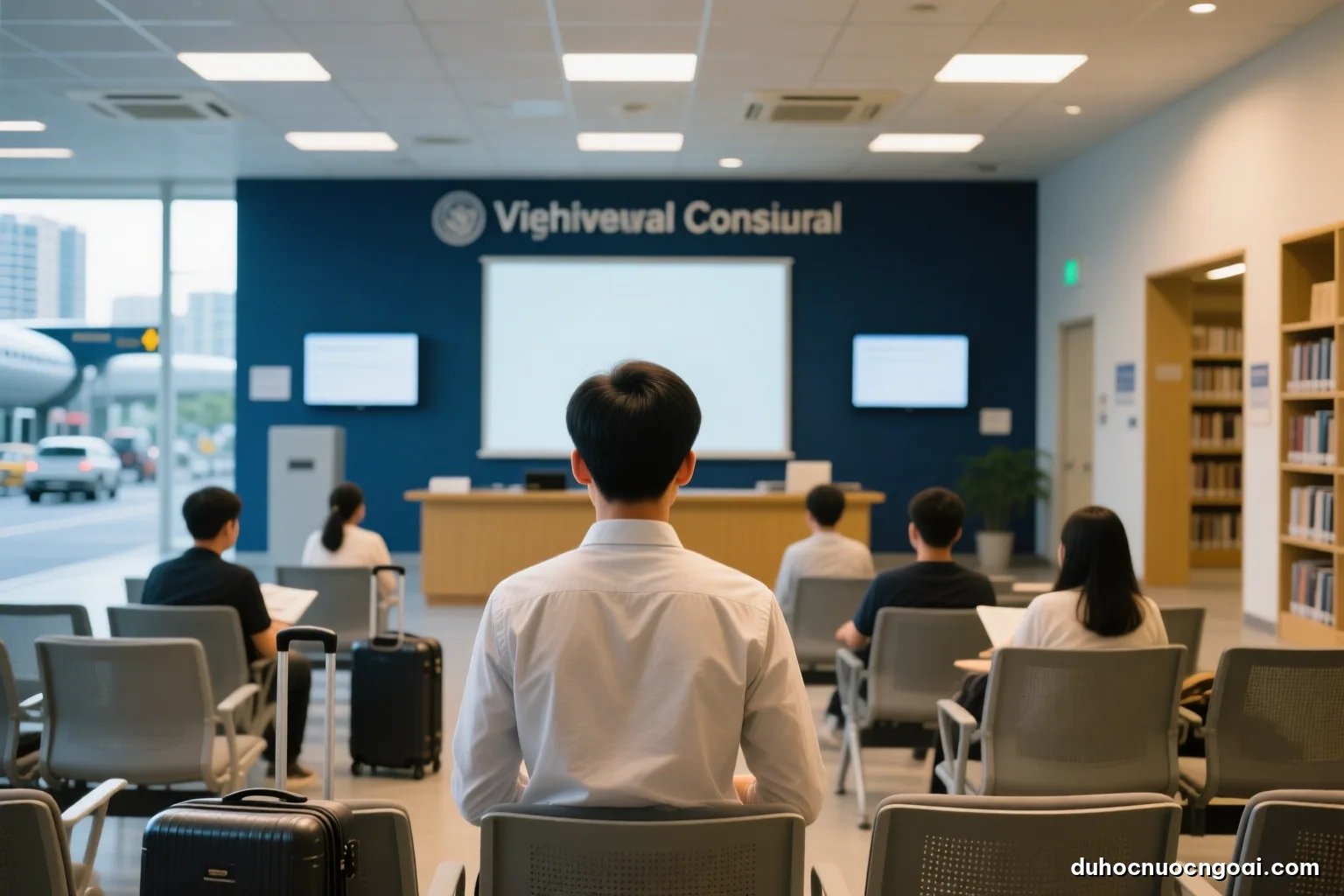
A student visa interview is a short conversation, often only a few minutes long, in which the officer checks three things directly: whether you genuinely intend to study, whether you have the financial and academic capacity, and whether you will comply with the visa conditions. The questions almost always fall into five groups: what you will study, why this institution and this country, who is paying, what you will do after graduating, and what ties you to Vietnam. Preparing well means knowing your own application thoroughly and answering briefly, truthfully and specifically — not memorising a script.
Not every country interviews every applicant. The US F-1 visa almost always involves an in-person interview; the UK may invite applicants to a credibility interview; Germany, South Korea and some other countries interview depending on the case; Canada and Australia mostly assess on paper but have the right to call an interview. This article explains each format, then goes into general preparation for any interview.
Which countries interview, and in what form
The format and extent of interviews differ greatly between countries. Knowing the format in advance helps you prepare with the right focus.
| Country | Usual format | Focus |
|---|---|---|
| US (F-1) | In-person interview at the Embassy in Hanoi or the Consulate General in Ho Chi Minh City, usually in English, very short | Purpose of study, finances, intention to return under 214(b) |
| UK (Student) | Credibility interview by video for some selected applications | Understanding of the course, institution and plans; being a "genuine student" |
| Germany | Possible interview when applying for the visa; in some cases an interview at the APS stage | Subject knowledge already acquired, study plan, language |
| South Korea | Possible interview at the consulate or through the institution | Language ability, purpose of study, finances |
| Canada, Australia | Mainly assessed on paper; may call an interview or request more documents | Study plan, finances, Genuine Student |
From 2025 the US significantly narrowed the categories eligible for an interview waiver and requires applicants to apply in their country of nationality or residence; also from mid-2025, US student visa applicants are required to set the social media accounts declared on their form to public. These rules may change further, so read the guidance on the website of the US Embassy in Vietnam just before booking an appointment.
The five groups of questions and what the officer really wants to hear
What you will study and why this field. The officer wants to see a thread connecting your academic past with your current choice. A good answer mentions a specific experience that led you to the field — a subject, a project, a job — rather than "because this field has lots of opportunities". Knowing the names of a few first-year modules is the clearest evidence that you did your own research.
Why this institution, this country. Your reasons should be tied to the programme: the department's strengths, the way of learning (practical work, research, co-op), proximity to the relevant industry. Weak reasons: "the university is highly ranked", "my friend studies there", "it is easy to get in". If asked which other institutions you applied to, answer truthfully and explain your selection criteria.
Who is paying and with what. Know what your parents do for a living, roughly what they earn each year, and what the total first-year cost is according to your enrolment document. A student does not need to memorise every figure on the bank statement, but not knowing what your parents do or roughly what the costs are is a bad sign.
What you will do after graduating. A specific, reasonable, verifiable plan: the type of job, the field, and why this qualification helps. If you intend to stay and work for a while through a lawful route, say so honestly and explain your long-term plan.
What ties you to Vietnam. Family, career opportunities, assets, the family's business plans, a commitment to a scholarship provider. For young students, the officer understands that ties are mainly family and future career, and does not expect property in your own name.
Common questions to practise with
The list below is not for memorising answers, but to make sure you have a genuine answer for each point. The officer may ask in many different ways.
- What will you study, at which institution, when does it start and how long is it?
- What do you know about this programme? Name a few modules you will take.
- Why not study this field in Vietnam?
- Which other institutions did you apply to and get into? Why did you choose this one?
- Who is paying your tuition and living costs? What do they do for a living?
- Roughly how much is the total cost of the first year?
- Do you have relatives in that country?
- What do you plan to do after graduating? Where?
- Have you travelled abroad before? Have you ever been refused a visa?
- What is your language test score? (sometimes the officer just needs to hear you speak to judge for themselves)
The two questions most likely to go wrong are "why not study in Vietnam" and "what will you do after graduating". For the first, do not criticise education at home; talk about the specific differences of the programme. For the second, link your answer to a real career path, not a vague job title.
How to answer: brief, truthful, specific
A US visa interview may last only two to three minutes, which means you have time for a few answers. A good answer is usually one to three sentences: answer the question directly first, then add one specific detail. For example, asked "why did you choose data science", the answer "because this field is growing" gives the officer no information; the answer "I did a sales data analysis project for my family's shop in Year 11 and want to learn statistics properly, and the programme has an applied statistics module in the second year" shows both motivation and understanding.
Telling the truth matters more than speaking well. Officers have heard thousands of memorised answers and recognise them very quickly. An answer that stumbles a little but is true and matches the application is far better than a smooth paragraph that does not fit the documents. If you do not understand a question, ask for it to be repeated; if you do not know, say you do not know rather than guessing.
Language: for a US visa and a UK credibility interview, your spoken English is also being assessed. If the course is taught in English and you cannot answer simple questions, the officer has reason to doubt your ability to study. US interviews sometimes allow you to choose Vietnamese with an interpreter, but answering in English yourself, if you are able to, is an advantage.
A two- to four-week preparation plan
A reasonable preparation time for most students is two to four weeks after receiving the enrolment document and finishing the financial documents.
- Reread your whole application as submitted or as you will bring it: the online form, the enrolment document, the study plan, the financial documents. Everything you say must match these.
- Research the programme: modules, length, assessment, city, costs. Write it all on one page.
- Write key points for the five groups of questions as bullet points, not as an essay to memorise.
- Practise out loud with someone unfamiliar with your application, and let them ask random and probing questions.
- Record a practice session on audio or video and listen back to cut rambling sentences and filler words.
- Prepare the documents to bring according to the consulate's guidance, arranged in order, with originals and copies.
- On interview day: arrive on time for your appointment, dress neatly, switch off your phone and bring only permitted items.
Mistakes that ruin an interview
Memorising a script. Answers identical to a template, pauses in the wrong places, not answering the question actually asked. The officer usually follows up straight away and the script collapses.
Saying something different from the application. Saying your father runs a business when the form says he is an office worker; saying the course is two years when the enrolment document says four. Even a small contradiction is enough to lose the officer's trust.
Handing over documents when not asked. US officers usually decide based on what you say; constantly offering documents shows you lack confidence in your answers. Only hand them over when asked.
Letting parents answer for you. Parents may accompany you to the gate where the rules allow, but the person being interviewed is the student. A student who cannot talk about their own plans is a sign that someone else made the decisions.
Arguing when refused. If you are refused on the spot, take the letter, say thank you, leave and analyse it later. Arguing will not change the decision and may be noted on your file.
After the interview: possible outcomes
For a US visa, the result is usually given at the window: approved (your passport is kept so the visa can be affixed), refused (you receive a letter citing the provision), or further administrative processing needed. Administrative processing can take from a few days to many weeks with no way to speed it up, so interview early, not close to the start date.
For countries that assess on paper, after a credibility interview or after biometrics, the result is communicated through your online account or by email. While you wait, check your inbox regularly, because requests for further documents usually have a short response deadline. Do not book non-refundable flights before you have the visa in hand.
If you are refused, keep the refusal letter and immediately write down the questions you were asked and the answers you gave, while your memory is still clear. These notes are the most valuable data for fixing your application next time.
If you are granted the visa, check the details printed on it straight away: full name, date of birth, passport number, visa type, validity, and the institution's name if it is shown. A mistake by the issuing authority can still cause problems at entry, and correcting it while still in Vietnam is far easier than at the border control desk. When you travel, carry the original enrolment document and financial documents in your hand luggage, because the border officer may ask about them again.
Frequently asked questions
How long does a US student visa interview last?
Usually only a few minutes, sometimes two to three minutes. A short interview does not mean a good or bad result; the officer has already read your application in the system and only needs to confirm a few points. So each answer should get straight to the point.
Can I bring documents into the interview?
Yes, and you should bring all the documents on the consulate's list, arranged so you can find them quickly. But only hand them over when asked. Electronic devices and large bags are usually not allowed, so read the rules on permitted items before your appointment.
If my English is not good, should I do the interview in Vietnamese?
If the consulate allows it and you are not confident, an interpreter helps avoid misunderstandings. However, for a course taught in English, the officer may want to hear you speak English to judge whether you can cope with the studies. Practising so you can answer basic questions in English is the safest approach.
Can parents attend the interview with the student?
It depends on each consulate's rules. For minors, parents are sometimes allowed to accompany them; for adults, usually only the applicant goes in. Even when parents are present, the student should answer the questions about the study plan themselves.
How is a UK credibility interview different from a US visa interview?
The UK interview is usually by video, only applies to some selected applications, and focuses on how well you understand the course, the institution, the costs and your plans. The US interview takes place for almost all F-1 applications, is shorter, and places heavy emphasis on intention to return under US law.
If I am refused on the spot, can I ask for the reason?
You can ask politely, but the officer will usually just hand you a letter citing the applicable provision. Do not argue. Write down what happened at the interview straight afterwards so you can analyse it, and only reapply once your application or circumstances have genuinely changed.