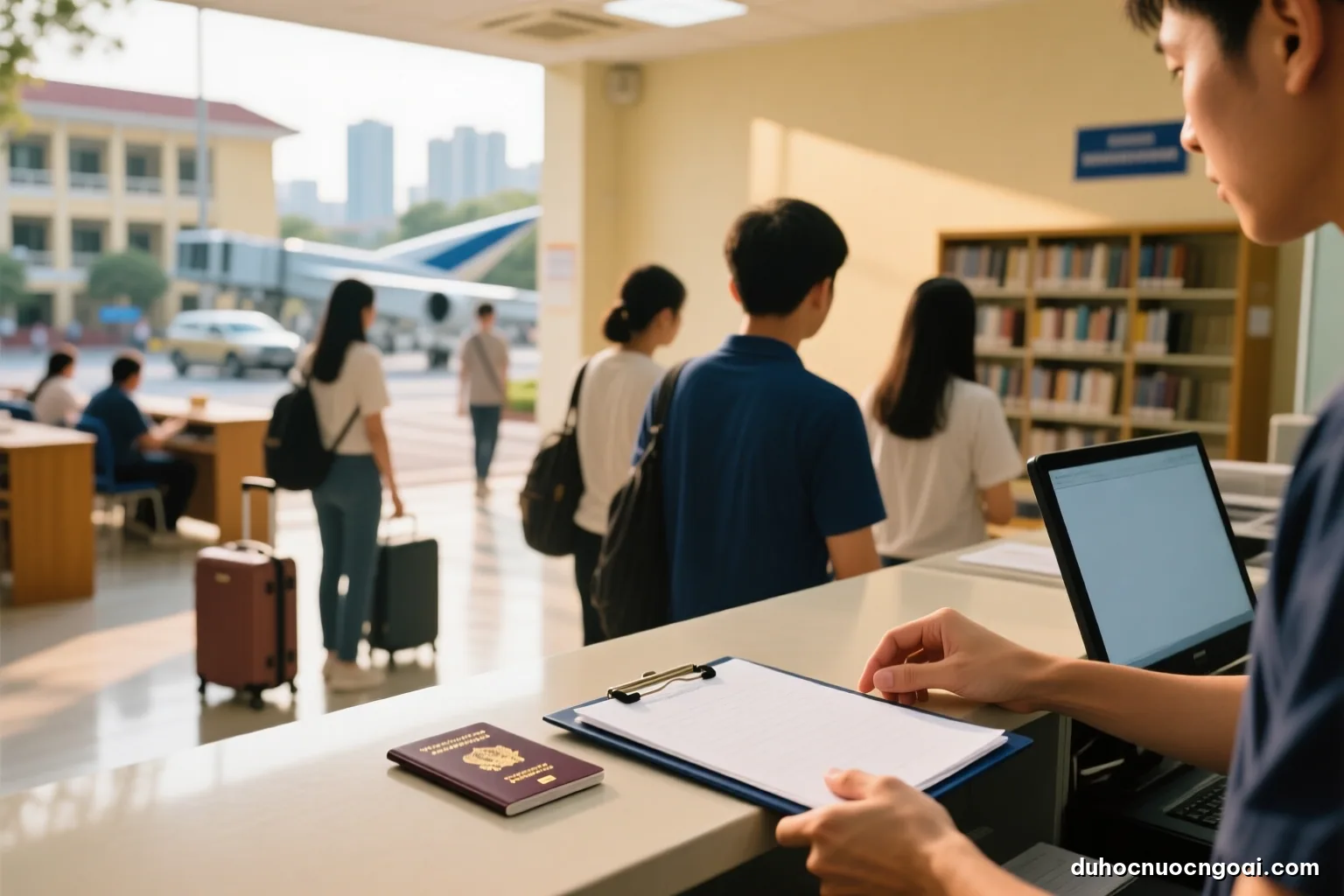
The Student visa is the visa for people aged 16 and over taking long courses in the UK, replacing the old Tier 4 name from October 2020; applications are assessed on a points-based system covering a CAS from a licensed institution, financial capacity and English at the required level. From Vietnam, you apply online, pay the visa fee and the Immigration Health Surcharge (IHS), then attend an application centre to give biometrics; standard processing usually takes about 3 weeks from the biometrics appointment.
The fee for a student visa applied for from outside the UK is £524 from April 2025, and the IHS is £776 for each year of the visa; both figures change with each round of adjustments, so check the UK government website before applying. This article lists the documents, the steps, the rights and limits that come with the visa, and the reasons for refusal that commonly arise in Vietnamese applications.
The documents you need for a Student visa
The list below is the core set of documents for an application made from Vietnam. Individual cases may need more; the official list is in the UK government's Student visa guidance:
- Passport, valid and with blank pages; old passports if you have a travel history.
- CAS number from the university, with the documents the university used to admit you (degree, transcript, English certificate) as listed on the CAS.
- Proof of funds: statements or a balance confirmation covering 28 consecutive days, in your own or a parent's account.
- Birth certificate and parental consent letter if you use your parents' money; a consent letter covering accommodation and travel if you are under 18.
- Tuberculosis test certificate from a clinic approved by the Home Office, compulsory for residents of Vietnam applying for a visa of more than 6 months.
- ATAS certificate if you are studying certain postgraduate subjects in sensitive areas of science and technology; the CAS will say if it is needed.
- English translations of every document not in English, certified by the translator.
- Evidence of English of the type the institution used: degree-level universities assess it themselves, while below-degree courses need an approved test.
Visa officers may ask for any document the institution used to issue the CAS. So bring or upload all of them, even if the system does not make them compulsory.
The steps to apply from Vietnam
The standard process for applicants from Vietnam for a September intake:
- Receive the CAS after getting an unconditional offer and meeting the institution's conditions, such as a deposit and a pre-CAS interview. Check the details on the CAS carefully: name, date of birth, passport number, start date, tuition and the amount already paid.
- Take the TB test at an approved clinic in Vietnam; the certificate is valid for 6 months.
- Hold the funds for 28 days before applying; the last day of the 28-day period must be no more than 31 days before you apply.
- Complete the online application on the UK government website, no earlier than 6 months before the course start date. Pay the visa fee and the IHS.
- Give biometrics at the UK visa application centre in Hanoi or Ho Chi Minh City and submit or upload documents as instructed. You may be invited to a video interview to assess your study purpose.
- Receive the decision. The UK is moving to electronic visas (eVisas) linked to an online account, and biometric residence permits (BRPs) are no longer issued; depending on the timing and guidance, you may receive a temporary vignette to travel. Check your eVisa details as soon as it is granted.
- Enter the UK no earlier than 1 month before the course start date for courses longer than 6 months. Carry a printed copy of the CAS, the offer letter and your financial documents in case you are asked at the border.
A priority service with a surcharge is available at many centres, depending on the time of year. In the July–August peak season, waiting times can be longer, so apply as soon as you are eligible rather than waiting until just before your flight.
What you can and cannot do on a Student visa
Students at degree level or above at an institution with degree-awarding powers may work up to 20 hours a week during term; below degree level the limit is 10 hours. The limit applies to each week from Monday to Sunday and cannot be averaged or carried over. During official vacations according to the institution's calendar, you may work full-time. After your course officially ends, you may work full-time until your visa expires.
Some work is prohibited even for a single hour: self-employment or freelancing, working as a professional sportsperson or sports coach, working as an entertainer, and filling a permanent full-time vacancy. Breaching the work conditions can lead to the visa being cancelled and affect every future visa application, not only in the UK.
The visa lasts for the length of the course plus an extra period: usually 4 months after courses of 12 months or more, shorter for short courses. This period is for completing formalities, applying for the Graduate Route or preparing to go home. You must also notify and comply when things change: changing course, interrupting your studies, transferring institution. The institution is required to tell the Home Office if you stop attending.
Common reasons for refusal in Vietnamese applications
Finances in the wrong form. Money held for fewer than 28 days, a statement more than 31 days old, an account in the name of someone other than a parent, or a balance a few pounds short because of exchange rates. Keep a safety margin so currency movements do not pull the balance below the required level.
Failing the genuine student assessment. The visa officer may conclude you are not a genuine student if you cannot explain why you chose the course, how it relates to your plans, or if you say things that contradict your application.
Inconsistent documents. Names, dates of birth or study history that differ between the CAS, passport and qualifications. Even a small typo on the CAS should be corrected by the institution before you apply.
Not declaring visa history. Failing to declare a previous refusal, in the UK or another country, can be treated as deception and lead to a ban on applying for a period. Always declare fully and truthfully.
Missing the documents the institution used for the CAS. For example, the CAS says the institution assessed you on a specific certificate that is not in your application. Read the CAS carefully and prepare exactly what it lists.
False or altered documents. The consequences are more serious than any other reason, including a long-term entry ban. Do not use services that "polish" applications or provide fake proof of funds in any form.
A hypothetical example: total formality costs for a 12-month master's
The IHS is charged for the whole length of the visa, not just the study period. The visa for a 12-month course usually adds about 4 months after the course, for a total of about 16 months; any part-year of 6 months or less is charged as half a year, and more than 6 months as a full year. The table below illustrates the calculation with the fees published at the time of writing; it is not a quote:
| Item | How it is calculated | Hypothetical example |
|---|---|---|
| Student visa fee (applying from outside the UK) | Once per application | £524 |
| IHS | £776 per year, with a part-year of under 6 months charged as half a year | About 16 months: 1 year + half a year = £1,164 |
| TB test | According to the approved clinic's fee schedule | Check directly with the clinic |
| Translation of documents | By number of pages and translation provider | Depends on the provider |
| Priority service (if used) | A surcharge depending on the centre and the time of year | Optional |
The IHS and the visa fee are usually the two largest formality costs, and are refunded according to the rules if the application is refused or withdrawn before a decision: the IHS is usually refunded when a visa is refused, but the visa fee is not. Check the current refund policy before applying.
These costs are separate from the proof-of-funds amount; do not use money in the proof-of-funds account to pay the visa fees during the 28-day holding period, because the balance may fall below the required level.
After the visa: what to do in your first week in the UK
When you arrive at the university, your passport and visa status will be checked at enrolment; some universities require online confirmation of your eVisa. Log in to your eVisa account and check your personal details, the expiry date and work conditions. When applying for part-time work, you create a share code so the employer can check your right to work, instead of showing a card as before.
Register with a GP practice near where you live as soon as possible; do not wait until you are ill. Apply for a National Insurance number if you plan to work part-time; you can start working while waiting for the number if you can prove your right to work. Keep copies of the CAS, offer letter and university correspondence, because you will need them when applying for the Graduate Route or an extension.
Attend classes regularly: universities monitor the attendance of visa students and are required to report extended absences or withdrawal. If health or family problems force you to take time off, tell the university early to get advice on interrupting your studies and the effect on your visa.
The genuine student interview: how to prepare
Not every applicant is interviewed, but many applications from Vietnam are invited to a short video interview, usually in English. The interviewer wants to know that you are a genuine student: you understand the course, have sensible reasons for choosing the institution and the UK, have a clear financial plan and can talk about your plans after studying.
Common questions: why this course rather than studying in Vietnam; why this institution; what modules the course includes; who is paying and where the money comes from; what you will do after studying. Answer specifically, consistently with your personal statement and application; do not memorise model answers, because interviewers easily spot them and will probe further.
Your English is also assessed during the interview; if you have IELTS 6.5 but cannot answer a simple question, that is a warning sign for the visa officer. Practise talking about your own course and plans. If you want someone to review your application and practise the interview with you before you apply, the advisers at Global Gate Pass offer a free first session.
Frequently asked questions
What is the earliest I can apply for a UK student visa?
From outside the UK, no earlier than 6 months before the course start date on your CAS. Applying early helps you avoid the July–August peak, but you must have held the funds for 28 days and have a valid TB certificate at the time you apply.
What is the IHS, and do I need extra insurance?
The IHS is a health surcharge paid with your visa application that lets you use the National Health Service (NHS) like residents. Many students still buy travel insurance for belongings and trips, but it is not required for basic medical care.
Do I need to prove ties to Vietnam, as for a US visa?
The UK Student visa has no separate ties criterion like the US non-immigrant visa. However, the genuine student assessment still looks at your study plan, why you chose the course and your plans afterwards, so coherent answers are still essential.
Can I change course or institution while studying in the UK?
Yes, but you usually need a new CAS and may have to make a new visa application, depending on whether the change is at the same level, at the same institution or a different one. In some cases you must apply from outside the UK. Ask your institution's visa advice team before deciding.
Does a UK visa refusal affect visas for other countries?
Many countries' visa forms ask whether you have ever been refused, and you must answer truthfully. A single refusal for an administrative reason such as a shortfall in the funds period is usually not a major obstacle if it has been fixed; concealing it is what causes serious problems.
What extra do students under 18 need for a Student visa?
A letter of consent from both parents or a legal guardian covering travel, accommodation and care arrangements in the UK, with a translated birth certificate. Students aged 4 to 17 at independent schools can use the Child Student visa, which has its own requirements.