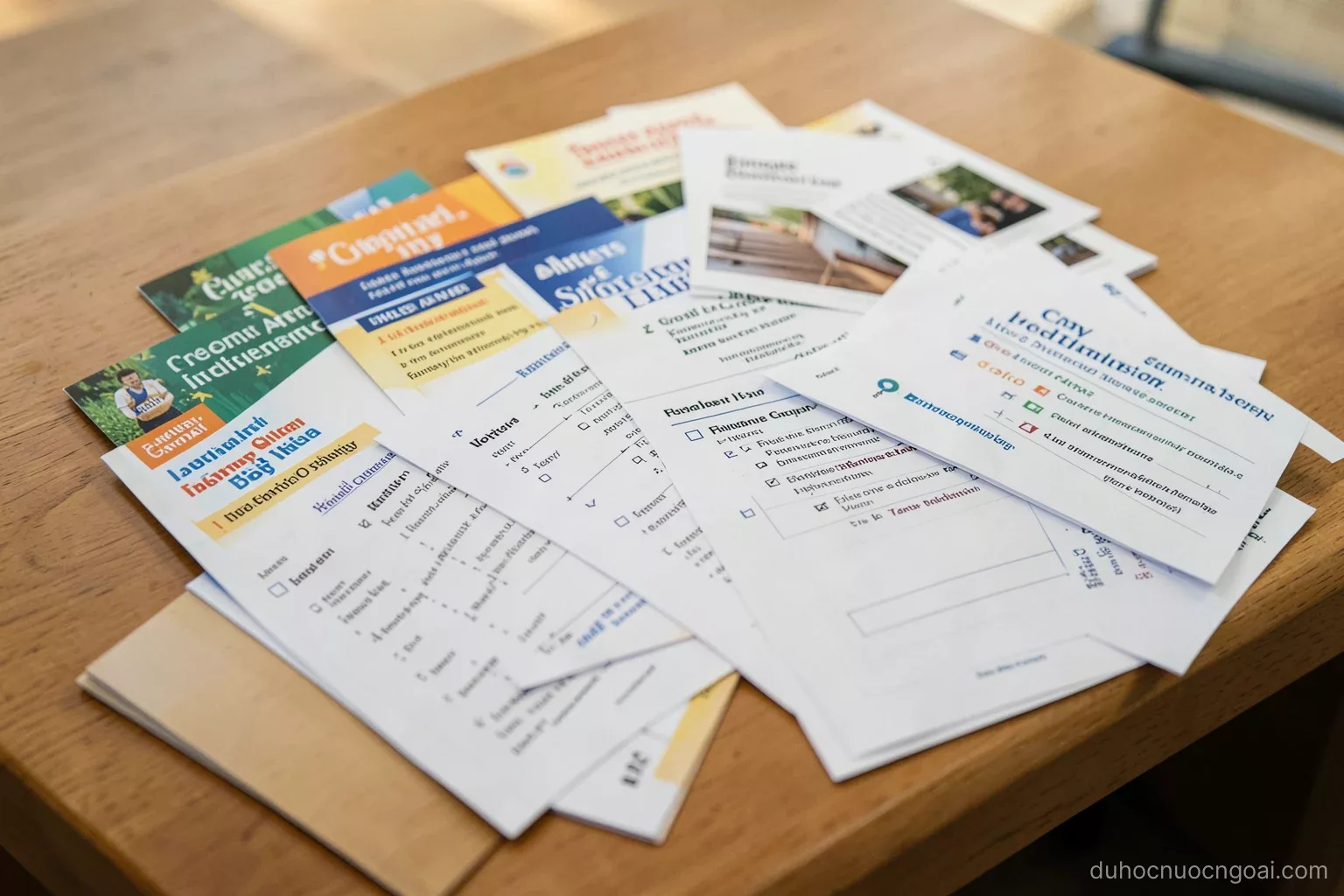
A Canadian study permit application includes: a letter of acceptance from a DLI (the LOA), a provincial attestation letter (PAL) or a CAQ if required, proof of funds, a study plan explaining why you chose this programme, your passport, photos, academic and employment documents, and then biometrics and an immigration medical exam when requested. The application is submitted online through an IRCC account; approved Vietnamese citizens receive an approval letter with a temporary resident visa, and the actual permit is printed at the port of entry.
The document list is not hard to find; the hard part is making the documents tell one consistent story. An officer often has only a few minutes for each application. This article goes through each component, explains what the officer is looking for in it, and how to arrange the application so it is easy to read.
The document list and the purpose of each item
The official checklist is generated individually in your IRCC account after you answer a questionnaire; the table below is a general framework for preparing in advance.
| Document | What the officer looks for in it |
|---|---|
| Passport, photos to specification | Identity and travel history; the passport should be valid for longer than your studies |
| LOA and PAL/CAQ | A real programme, verified by the institution, with a place within the allocation |
| Proof of funds | Enough for first-year tuition plus living costs plus travel, from a legal and stable source |
| Study plan | The reasons for choosing the field, institution and Canada; logical consistency with your past and future |
| School records, diplomas, transcripts, language certificates | Your ability to follow the programme |
| Employment documents (if you have worked) | Your career history and degree of attachment to Vietnam |
| Family documents | Your relationship with the sponsor and family ties |
| IRCC forms | Family, education, employment and travel history declared in full and matching your documents |
Vietnamese documents must be accompanied by an English or French translation, with the translator's declaration as IRCC requires. A translation with the wrong school name or job title is a small mistake, but it makes the officer lose confidence in the whole application.
The study plan: the most decisive part, and the one most often written badly
The study plan is the only place where you speak directly to the officer. A good one clearly answers five questions: who you are and what you have studied and done; why you chose this programme rather than a similar one in Vietnam or another country; why you chose this institution and city; how the programme will help in a specific job afterwards; and what your plan is when the permit expires.
The most common mistake is writing in generalities, praising Canada as safe, multicultural and high-quality in education. These sentences are true for everyone and so say nothing about you. The second mistake is contradiction: writing that you want to return to Vietnam to start a business but choosing an unrelated programme, or already having a master's but applying for a diploma in a different field without explanation. The third mistake is using a template; officers read hundreds each month and recognise template writing immediately.
The good way to write is to start from real details: which courses in the programme you need, which skills are lacking in Vietnam that the programme teaches, the specific job you are aiming for, which businesses or industries in Vietnam need people with those skills. If you have a gap in your studies or work, explain it briefly and honestly. One to two pages is enough; longer does not make the application stronger.
The study plan must be written by the student, or at least the student must understand and be able to restate every sentence. If asked on arrival, your answers need to match what you wrote.
The steps to apply online
For applicants in Vietnam, the process goes through IRCC's online portal. The steps below follow the usual order.
- Create an IRCC account and answer the questionnaire so the system generates your personal document checklist.
- Complete the electronic forms: personal details, family, education, employment and travel history for recent years. Declare everything, including any visa refusal from any country.
- Upload documents according to the checklist, with clear file names, combining multi-page files into one PDF in a logical order.
- Pay the processing fee and the biometrics fee online.
- Receive the biometrics instruction letter, book an appointment at a visa application centre in Hanoi or Ho Chi Minh City, and bring the letter and your passport to give fingerprints and a photo.
- If your application requires it, have an immigration medical exam with an IRCC-designated panel physician; the results go directly to IRCC.
- Monitor your account. Once approved, submit your passport for the visa and receive the Port of Entry Letter of Introduction.
Biometrics are valid for ten years; if you have given them for another application within that period, you may not need to give them again. The medical exam can be done before applying to save time, but results have a validity period, so do not do it too early.
Small things that get applications returned or delayed
Missing mandatory documents. An application without a verified LOA, without a PAL when one is needed, or without proof of funds may be returned without being assessed. In many cases the fee is not refunded.
Inconsistent declarations. Employment dates on the forms that differ from the employment letter, or different addresses across documents. Each small point does not get an application refused, but many of them together make the officer doubt your honesty.
Hiding a refusal history. IRCC shares visa data with some countries. Failing to declare a refusal of a US, Australian or UK visa may be treated as misrepresentation, with consequences far more serious than the refusal itself.
Unreadable files. Blurred, tilted or cropped photos, or files compressed so much that the text is lost. Scan with a scanner or a document-scanning app and check every page before uploading.
Applying too close to the start date. Applications submitted close to the start date often do not make it in time. The officer may also refuse on the grounds that you cannot arrive in time for the start of the programme.
Applications for students who are minors
The age of majority in Canada is set by each province: 18 in Alberta, Manitoba, Ontario, Prince Edward Island, Quebec and Saskatchewan; 19 in British Columbia, New Brunswick, Newfoundland and Labrador, Nova Scotia and the three territories. Students under this age who are not accompanied by a parent must have a custodian, an adult living in Canada who agrees to take responsibility for their care in place of the parents.
A minor's application needs an additional custodianship declaration on the IRCC form, signed by the parents in Vietnam and the custodian in Canada and notarised as instructed. Many secondary schools and school districts offer homestays with custodianship, or recommend professional custodianship organisations. If the custodian is a relative already in Canada, they need to show legal residence status and the ability to provide care.
Officers assessing applications from minors pay particular attention to safety: where the child will live, who will take them to and from school, who to contact in an emergency, who will deal with the school on the family's behalf. An application that sets these out clearly is more convincing than any statement about grades. For students in grades 10 to 12, families should also plan ahead for where the child will go to university, because moving to the next level means applying for a new permit and may require a PAL.
From approval to entering Canada
The Port of Entry Letter of Introduction is not a study permit. When you arrive at your first Canadian airport, you present this letter together with your passport containing the visa, your LOA, proof of funds and other important documents to the border officer. The officer may ask a few questions about your programme, accommodation and finances, then print the study permit.
Read the permit carefully right at the counter: name, institution, expiry date, and especially the condition line allowing off-campus work. If this line is missing when you are eligible, asking for it to be corrected on the spot is much easier than applying for a correction later. The permit is usually valid for the length of the programme plus an extra period; a permit shorter than your passport would allow is normal.
The temporary resident visa in your passport may expire before your study permit. You can still stay and study legally, but if you go back to Vietnam part-way through and the visa has expired, you must get a new visa before returning. Keep track of the expiry dates of both documents.
Doing the application yourself or using an agency
There is no rule that you must use an agency; many students apply themselves and are approved. Doing it yourself saves money and helps you understand your own application, which is useful at the border and when extending later. But it requires reading English guidance carefully, keeping up with policy changes and checking the consistency of dozens of documents yourself.
If you use a paid representative to submit your application, under Canadian law that person must be a member of the College of Immigration and Citizenship Consultants, a lawyer, or a licensed notary in Quebec. The representative's name is declared in the application. In Vietnam, study-abroad agencies must also comply with the regulations on study-abroad advisory services. Ask clearly who is legally responsible for your application.
A warning sign is a helper who does not want to be named as your representative in the application but still charges a fee for preparing it, or who suggests misstating facts to make the application look better. When things go wrong, it is the student who bears the consequences, not the person who wrote it.
Whichever way you choose, the student must read and understand everything submitted in their name. The advisers at Global Gate Pass work on this principle: students write their own study plan, and the adviser gives feedback and checks consistency.
Frequently asked questions
Do I need an employment letter if I have never worked?
No. Students who have just finished high school or university only need academic documents. If there is a gap between graduating and applying, briefly explain what you did during it, for example studying a language, preparing applications, or freelancing with supporting documents.
Is there an interview for a Canadian study permit?
Usually not; the officer assesses the application on paper. In some cases IRCC may invite you to an interview or ask for more documents. At the border, the officer may ask a few questions, so understand your application well.
Who may translate Vietnamese documents?
IRCC requires translations accompanied by copies of the original documents and the translator's declaration, according to current guidance. Applicants and their relatives may not translate documents for their own application. Read the translation requirements in the document checklist of your IRCC account carefully.
Where do I take the medical exam for studying in Canada?
Only physicians on IRCC's list of panel physicians may carry out immigration medical exams. The list of physicians in Vietnam is published on the Government of Canada website. Exams at any other facility are not accepted, however good the results.
Should I submit documents beyond the checklist?
Yes, when a document answers a question the officer might ask, for example explaining the source of funds, a gap in your studies or a change of field. Do not pad the application with irrelevant documents; a thick but disorganised application buries what matters.
I have a study permit but will arrive in Canada after my term starts. What should I do?
Contact your institution immediately to defer to the next term and ask for a letter confirming the new start date. Bring this letter when you enter Canada. The border officer may refuse entry if they find you are no longer enrolled in the programme stated in your approval letter.