An emergency plan for a child studying abroad has four parts prepared before the flight: a back-up set of documents (copies of the passport, visa, insurance and health records) that both your child and parents can access; a clear understanding of what your child's insurance covers; a contact list including the host country's emergency numbers, the university, the Vietnamese mission and the nearest people you know; and an agreement within the family about who does what when something happens. It takes an evening to prepare, but in a real situation it saves the most precious hours.
Most international students get through their whole course without a serious incident. An emergency plan is not about worrying in advance but about making sure that when something happens — appendicitis in the middle of the night, a bicycle collision, a bag snatched with the passport inside — both your child and the family know what the next step is.
A back-up set of documents
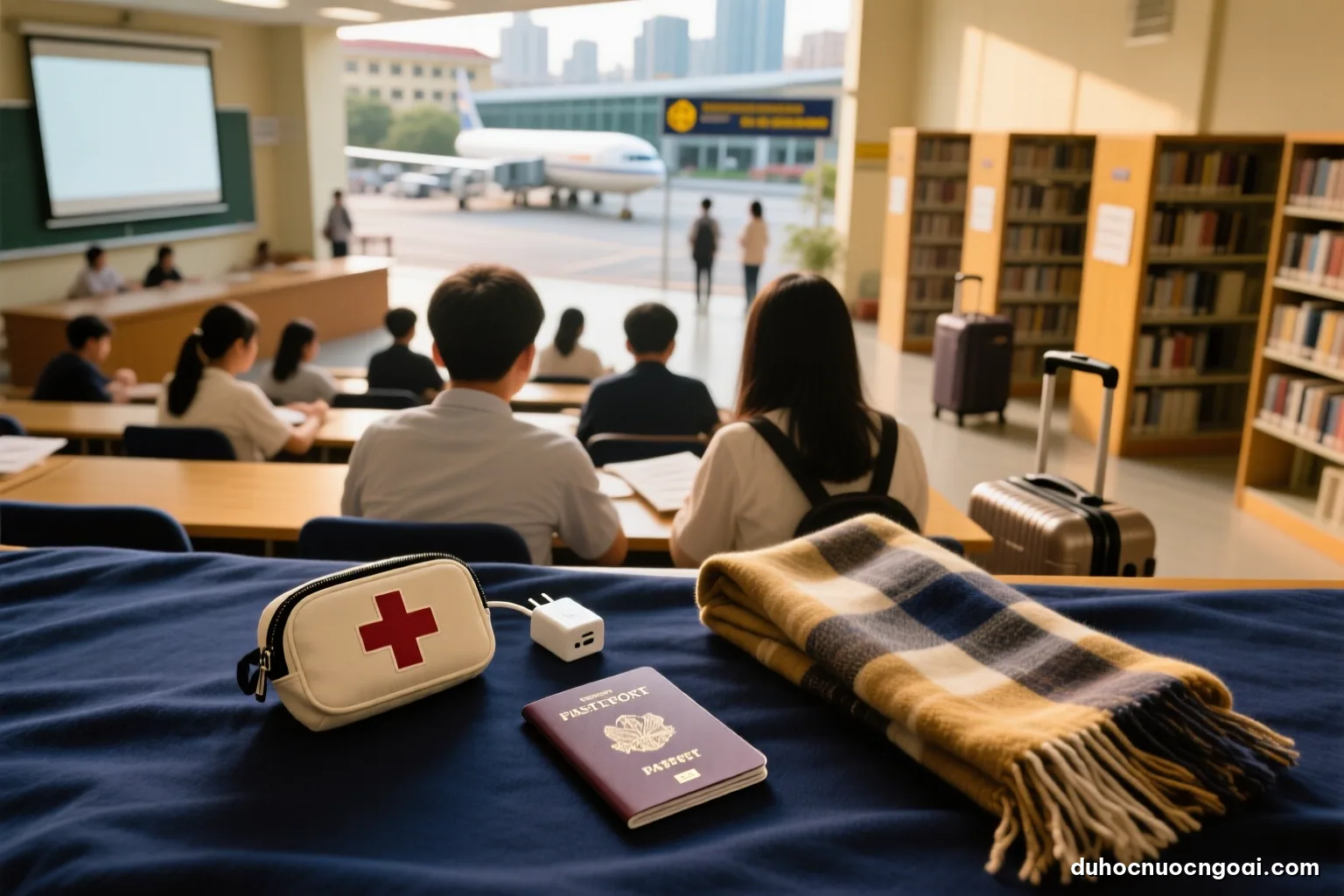
Photograph or scan the documents below and save them in a secure digital folder that your child and at least one parent can open. Your child takes a set of paper copies to keep separately from the originals.
- The passport information page, the visa page or residence card, and the confirmation of enrolment (CoE, I-20, CAS or the equivalent depending on the country).
- The health insurance policy and card, and the insurer's support helpline number.
- A health summary in English: blood type if known, allergies, chronic conditions, current medication (active ingredient names, not just brand names), vaccination history.
- Doctors' prescriptions for medicine your child takes with them, especially prescription drugs, to show at entry and when they need to buy more.
- The birth certificate and a Vietnamese identity document, useful when applying for replacement documents.
- Bank account details and how to block cards quickly.
- The tenancy agreement and the exact address where your child lives.
The digital folder should be protected with a strong password and two-factor authentication. This is your child's most sensitive set of documents — losing it to the wrong people is an incident of its own.
Insurance: read it before you need it
Many countries require international students to have health insurance: Australia requires Overseas Student Health Cover (OSHC) for the whole visa period; the UK charges the Immigration Health Surcharge (IHS) with the visa application so students can use the public NHS; the US has no universal coverage, so most universities require students to buy the university's plan or prove they have an equivalent one. Other countries have their own rules. What the family needs to know is not just "my child has insurance" but how far that insurance goes.
Questions to find answers to in the insurance policy: how GP and specialist visits are covered; whether emergency care, hospital stays and surgery have a cap; whether your child has to pay first and claim back; whether mental health and dental care are covered; whether pre-existing conditions are excluded or have a waiting period; and — something many basic plans do not include — the cost of repatriating the patient or of a relative travelling out to care for them.
If the compulsory plan lacks the parts the family worries about most, you can buy additional cover. Also tell your child to save the insurer's support helpline: many insurers have a twenty-four-hour line that helps find a suitable medical facility and guarantees hospital fees in case of admission.
A gap that is often overlooked is the time before the university's insurance takes effect, and trips outside the host country. Some plans only start on the enrolment date, while your child flies out a few weeks earlier; some do not cover your child when travelling to another country during the holidays. Check the start date, end date and territorial scope of the policy, then buy short-term travel insurance for the remaining gaps.
Emergency numbers in some popular destinations
Your child should save the emergency number of their destination country in their phone as soon as the ticket is booked. The table below gives the common numbers; your child should check them again on the official website of that country and the university's website.
| Country | General emergency number | Notes |
|---|---|---|
| US, Canada | 911 | Police, ambulance, fire |
| United Kingdom | 999 or 112 | 111 for non-emergency medical situations |
| Australia | 000 | From mobile phones 112 also works |
| New Zealand | 111 | Police, ambulance, fire |
| European Union countries | 112 | Many countries also have separate numbers for each service |
| Japan | 110 (police), 119 (ambulance, fire) | Practise saying your home address in Japanese |
| South Korea | 112 (police), 119 (ambulance, fire) | There is a multilingual helpline for foreigners |
| Singapore | 999 (police), 995 (ambulance, fire) | Do not call 995 for non-emergencies |
Besides emergency numbers, each university usually has a twenty-four-hour campus security number. Your child should save it together with the address of the university health centre during orientation week.
The Vietnamese mission and consular protection of citizens
Vietnamese embassies and consulates general abroad have a duty to protect citizens: helping when citizens lose their passports, have accidents, are detained, face natural disasters or other difficulties. Each mission has a citizen protection hotline, published on its website. Your child should save this number before flying, and the family should keep a copy too.
If your child loses their passport, the usual sequence is to report it to the police where it was lost to get a confirmation, then contact the Vietnamese mission to apply for a new passport or a replacement travel document. After that, your child must tell the university and complete the procedures with the host country's immigration authority for the visa or residence card linked to the old passport. Having passport copies and passport photos ready shortens the process considerably.
Some missions encourage citizens to register their details when they come to live or study long term, so that they can be contacted in a natural disaster or unstable situation. The Vietnamese student association in many cities is also often the first and fastest source of help in the first days of an incident.
When your child falls seriously ill or has an accident: what the family does
Bad news arriving in the middle of the night in Vietnam is what many parents fear most. Having a sequence ready helps parents act instead of panic.
- Confirm the source: who is reporting it and through which channel. If it is an unknown caller demanding an urgent money transfer, stop and check yourself through the official number of the university or hospital — this is a familiar scam script.
- Get the basic information: which medical facility your child is at, what their condition is, who is with them.
- Contact your child's insurer through its support helpline to open a case, and ask about guaranteed hospital payment and related benefits.
- Tell the university: the international student office or student support service helps contact the hospital, arranges study matters, and can support the family with procedures.
- If a relative needs to travel out, check the type of visa and processing time; some consular authorities have fast-track arrangements for urgent humanitarian cases. The Vietnamese mission in the host country can help with information.
- Keep notes of every call, the names of contacts and the documents received — for insurance claims and later procedures.
- Once things are stable, look at study matters with your child and the university: applying for special circumstances, a reduced load or a break under the rules.
When your child gets into trouble with the law in the host country
This is rare, but every family should know how to handle it: your child is held by police over a misunderstanding, a traffic collision, or a breach of a rule they did not know — carrying prohibited food or medicine, working more hours than permitted, using a controlled substance that is allowed in other countries. Under the Vienna Convention on Consular Relations, a foreign national who is detained has the right to ask the authorities to notify their country's consulate. Your child should know this right and know to ask for the Vietnamese mission to be contacted.
Tell your child the basic principles: stay calm and polite, do not resist; do not sign documents you do not understand; you have the right to ask for an interpreter and a lawyer under that country's law; tell the family or a trusted person as soon as possible. Many universities have free legal advice services for students or can refer them to legal aid. The family at home should contact the Vietnamese mission and the university, and avoid sending money to anyone who claims they can "sort things out" for your child — this too is a scam script that has been seen.
A family agreement: who does what when something happens
Besides documents, an emergency plan needs a simple agreement between family members. Who is the main emergency contact in the university's records — ideally someone who speaks English, can respond quickly and stays calm. Who has a valid passport and is ready to fly if needed. Who holds access to the back-up document folder and the emergency fund account.
For pupils under eighteen, a parental authorisation letter is also needed allowing the guardian or school to make emergency medical decisions — many boarding schools and guardianship organisations require it at enrolment. The family should read the scope of the authorisation carefully and keep a copy.
Finally, talk to your child about this plan calmly, like checking seat belts before driving, not to frighten them. Knowing the family has prepared also makes your child more confident in handling small incidents themselves, and in knowing exactly when to call home.
Frequently asked questions
Who pays the hospital bill if an international student falls seriously ill abroad?
Mainly your child's health insurance, within the scope of the policy; anything above the cap or excluded has to be paid by the family. In the UK, students who have paid the health surcharge can use many NHS services like residents. The family should read the benefits and coverage caps carefully before your child leaves.
What should your child do first if they lose their passport abroad?
Report it to the police where it was lost to get a confirmation, contact the Vietnamese mission for a new passport or replacement document, then tell the university and complete the procedures with the immigration authority for the visa or residence card. Having passport copies and photos ready makes the process much quicker.
Do you need extra insurance beyond the compulsory plan?
It depends on what the compulsory plan covers. If it does not include repatriation, costs for a relative to come and care for your child, or dental care, or has low caps, the family may consider additional cover. Compare the scope, exclusions and claims process before choosing.
What does the Vietnamese embassy help international students with?
Missions have a duty to protect citizens: reissuing passports or replacement documents, helping when citizens are detained, have accidents or face natural disasters, and liaising with the family and local authorities. The mission does not replace insurance or pay medical costs, but it is an important point of contact in a major incident.
What extra emergency documents does a child under 18 at secondary school need?
Usually a parental authorisation letter allowing the guardian or school to provide care and make emergency medical decisions, along with contact details for both sides. Specific requirements follow each country's and school's rules, so ask the school and the guardianship organisation during enrolment.
If parents want to fly out immediately when something happens, will the visa come in time?
It depends on the country and on the parents' existing passports and visas. Some consular authorities have urgent humanitarian processing, which requires supporting documents such as a hospital confirmation. Keeping valid passports and considering a family visit visa in advance is the most proactive approach.