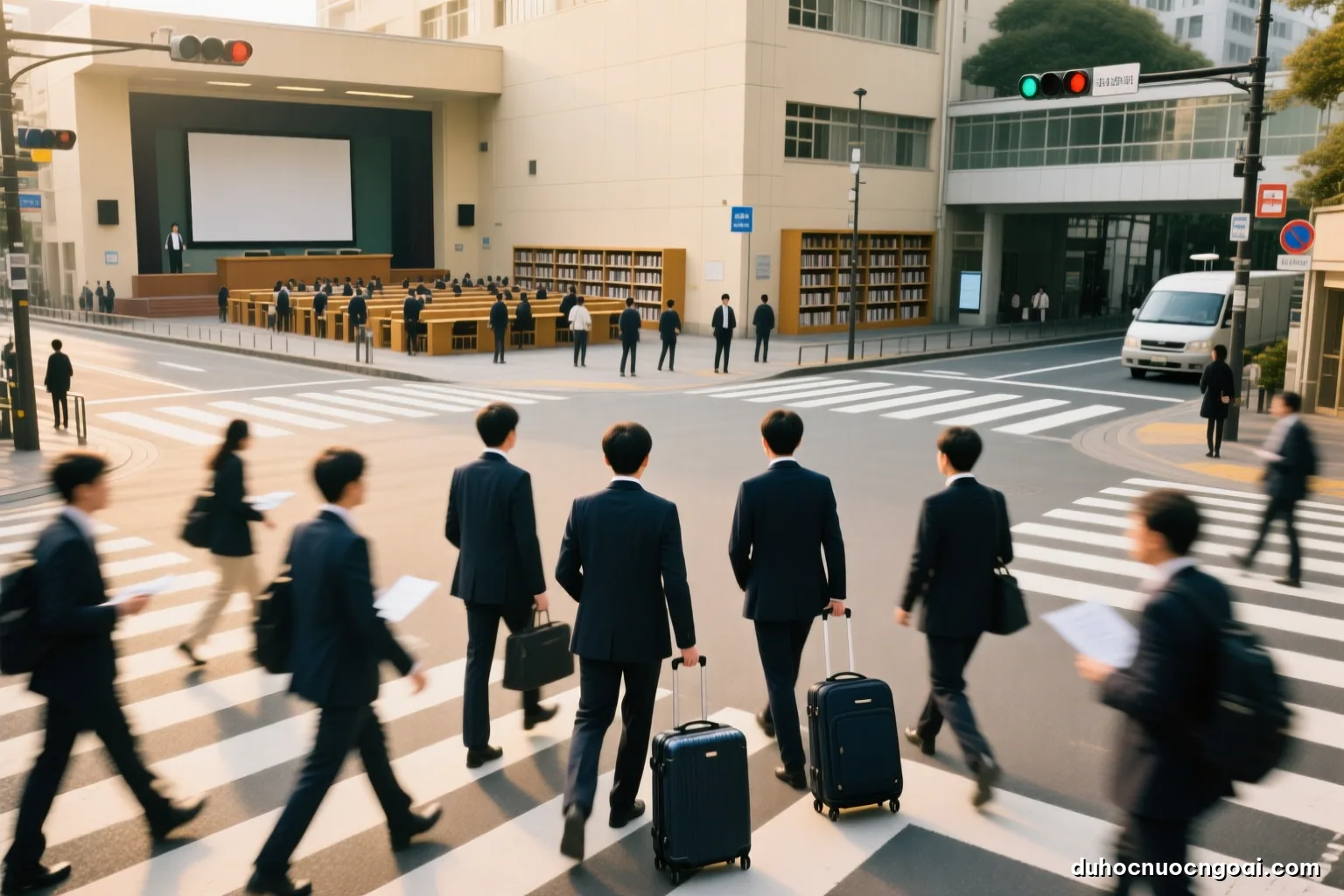
A senmon gakko (specialized training college) teaches applied vocational skills over 2–4 years and awards the senmonshi or kodo senmonshi title; a university provides a broad academic foundation over 4 years and awards a bachelor's degree. Choose senmon if you already know the job you want and want to start working in Japan early; choose university if you need a broad foundation, want to go on to graduate school, or want to keep more career and country options open later.
Most Vietnamese students face exactly this choice after language school. The two paths differ in teaching style, entry requirements, cost and, above all, in how much flexibility you have when switching to a work visa. This article compares each point and shows how to answer the question "which one suits me" for yourself.
What a senmon gakko is and why it is popular with Vietnamese students
In the Japanese education system, a senmon gakko is a type of specialized training school (senshu gakko) offering a post-secondary course for people who have completed 12 years of schooling. Teaching is practical: information technology, graphic design, animation, cooking and baking, tourism and hospitality, business, automotive, electrical work, architecture, nursing care, beauty… Classes are smaller than at university, timetables are packed, and there are internships with companies.
Completing a course of two years or more that meets the ministry's standards earns the senmonshi title; a four-year course meeting a higher standard earns the kodo senmonshi title, which counts as equivalent for graduate school entry. Neither is a bachelor's degree, and this has consequences when applying for a work visa or if you later want to move to a third country.
Senmon is popular with Vietnamese students for three reasons: it is shorter than university, entry usually does not require the EJU, and many fields are directly linked to Japanese companies' hiring needs. However, studying at a senmon in Japanese alongside Japanese students requires genuine language ability, not just enough to get in.
Senmon gakko and Japanese universities compared
The table compares the points families usually weigh up. Durations are typical; individual schools and fields may differ.
| Criterion | Senmon gakko | University |
|---|---|---|
| Duration | 2 years is common, some fields 3–4 years | 4 years (medicine, pharmacy, dentistry usually 6 years) |
| Qualification | Senmonshi (2 years+), kodo senmonshi (4 years) | Bachelor's degree |
| Japanese at entry | Usually around N2, or completing the required period at a Japanese language school | Usually N2–N1, plus an EJU Japanese score |
| Admission | Document review, interview, short essay, sometimes a language test | EJU, the university's own exam, interview, essay |
| Teaching style | Lots of practice, small classes, strict attendance | Broad theoretical foundation, much independent study, seminars and a thesis |
| Switching to a work visa | The job must be closely related to the field studied | A broader range of related jobs across many fields |
| Further study | Kodo senmonshi holders can sit graduate school entrance; senmonshi holders can transfer into year 3 at some universities | Straight on to graduate school in Japan or elsewhere |
The "switching to a work visa" row is the one many people overlook. Under the "Engineer/Specialist in Humanities/International Services" status, senmon graduates are usually examined closely on how well their field of study relates to the job. For example, studying graphic design at a senmon and then applying to work as an accountant is unlikely to be approved. Bachelor's degree holders are viewed more broadly.
Entry requirements for senmon gakko for international students
Education. Completion of 12 years of schooling. Students at a Japanese language school submit a certificate of enrolment along with their results and attendance at that school.
Japanese. The usual requirement for international students entering senmon is one of the following: JLPT N2, a certain score in the Japanese section of the EJU or in the BJT Business Japanese test, or having completed the required period at an accredited Japanese language school. The exact level is set by current rules and by each school, so check the admissions announcement.
Attendance at language school. Senmon schools, and immigration too, look at attendance rates. Low attendance is a common reason why applications to change school or renew residence run into difficulty.
Interview and essay. Schools ask why you chose the field, how you researched the profession and what you plan after graduating. Vague or memorised answers are easily rejected, especially in popular fields.
Finances. Schools check your ability to pay tuition; some require the financial sponsor to recommit when moving up from language school.
Japanese universities: national, public, private and how to get in
Japanese universities fall into three groups. National universities (such as Tokyo, Kyoto, Osaka, Tohoku, Nagoya, Kyushu and Hokkaido) charge tuition at a standard state rate, lower than private ones. Public universities are set up by prefectures or cities, with tuition close to national levels. Private universities (such as Waseda, Keio, Sophia and Ritsumeikan) are the majority, with higher tuition that varies a lot between fields.
Self-funded international students usually enter university through admissions rounds reserved for foreign applicants. Assessment includes EJU scores (subjects depend on the field), English certificates such as TOEFL or IELTS at many national universities, the university's own exam, an essay and an interview. Each university, and even each faculty, publishes its own admission guidelines (boshu yoko), which you must read line by line.
There are also English-taught bachelor's programmes at some large universities, assessed in the international way: school transcripts, an English certificate, SAT or equivalent scores, essays and recommendation letters. This route does not need a language school, but students should still learn Japanese while studying to keep the option of working in Japan later.
Adding up the total time and cost of the whole journey
Comparing senmon and university by one year's tuition is incomplete. Add up the whole journey: a student who goes to language school and then a two-year senmon usually spends about three and a half to four years in Japan before earning the senmonshi title; a student who goes to language school and then university spends about five and a half to six years before earning a bachelor's degree. A two-year difference means two more years of tuition, rent and living costs, and two more years without full-time income.
On tuition, national universities apply the state standard rate, which for many years has been 535,800 yen per year plus an enrolment fee of 282,000 yen; some universities have been allowed to charge above the standard, for example the University of Tokyo raised undergraduate tuition from 2025. Private universities and senmon schools set their own fees, usually higher than national ones and varying a lot by field: fields that need workshops, equipment and materials such as cooking, automotive and design usually cost more than business.
The right approach is to build a table for each option, one row per year, with tuition from the published fee schedule, rent for the city, living costs, insurance and flights. Looking at the whole journey, many families realise that a national university takes longer but costs not much more than a private senmon, whereas a private university in engineering costs clearly more.
How a week at senmon differs from a week at university
At senmon, the timetable is more like a high school: classes from morning to afternoon almost every day, a fixed class of a few dozen students, and the teacher takes attendance at every session. Most hours are practical: writing programs, producing design work, cooking, repairing machines, role-playing receiving guests. Assignments are concrete products with frequent deadlines. The final year usually includes a company internship and job hunting closely guided by the school.
At university, the first year covers general education and languages, students choose their own classes, and there is more free time but much more reading and report writing. From the third year, students join a professor's seminar (zemi), do small research projects and write a thesis. Independent study is the bulk of the work; nobody reminds you to revise. Club activities (sakuru) are where you make Japanese friends and practise the language naturally.
People who like working with their hands and seeing results immediately usually suit the senmon rhythm. People who like reading, arguing a case and managing their own time usually suit university. Neither is easier: senmon is heavy on contact hours, university is heavy on self-discipline.
Where to stay alert when choosing a senmon
Some senmon departments mainly teach Japanese language or "Japanese culture" to foreigners. Studying there is valid for residence status, but on graduating it is hard to show that the field relates to a specific professional job, so switching to a work visa can run into obstacles. If your goal is to work in Japan, choose a department with clear vocational content.
Since 2023, MEXT has had a programme certifying senmon courses that focus on helping international students build careers in Japan, and graduates of these courses are assessed more flexibly on how their field relates to their job. This is a plus worth asking about when choosing a school, but how it applies may change, so check the current information.
Also ask the school about its student mix: a class made up almost entirely of international students may be easier to follow but offers fewer chances to use Japanese with native speakers, and employers sometimes view the two types of class differently. Ask too about the rate of finding field-related jobs among international graduates, not just the school's overall rate.
How to decide: five questions in order
Instead of asking "is senmon or university better", answer the following five questions in turn. The answer usually becomes clear on its own.
- Do I already know what job I want? If yes, and that job is learned mainly through practice (application programming, chef, design), senmon makes sense. If not, university gives you more time to explore.
- Do I want to stay in Japan long term, or go back to Vietnam or on to another country? A bachelor's degree is more easily recognised in a third country and for further study. The senmonshi title is valued mainly in the Japanese job market.
- How good are my Japanese and my academic foundation right now? The EJU needs a solid base in mathematics and science or social studies. Students with a weaker academic base who are hard-working and good with their hands can shine at senmon.
- How many more years of tuition can the family guarantee? University is two years longer than senmon; the total cost must be calculated in advance, without relying on part-time work.
- Does my dream job require a bachelor's degree? Some positions at large companies, in finance or research, or visas in other countries require one. Check real job advertisements for that profession.
Frequently asked questions
Can I go on to university after senmon?
In many cases, yes. Some universities accept senmonshi holders as transfer students into the third year, depending on the field and the university. Kodo senmonshi holders are eligible to sit graduate school entrance exams. Check each university's transfer conditions, because it is not automatic.
Do senmon schools require the EJU?
Most senmon schools do not require the EJU; they assess documents, Japanese, an essay and an interview. However, an EJU Japanese score can be one way to prove your language level. Read the admissions guidelines of the specific school.
Which senmon fields do Vietnamese students often choose?
Common fields are information technology, international business, tourism and hospitality, design, cooking, automotive and nursing care. Choose a field based on genuine interest and your ability to study it in Japanese, not just on rumours about which field makes it easy to get a job.
Are private universities much more expensive than national ones?
Usually, especially in medicine, dentistry, science and engineering at private universities. Many private universities reduce tuition for self-funded international students based on results. Compare using each university's published fee schedule for your intake year.
Can senmon graduates get a work visa?
Yes, if the job is related to the field studied and meets the other conditions of the residence status. Immigration examines this relationship quite strictly for senmon graduates, so think about your future job when choosing the field in the first place.
Should I choose senmon just because it is shorter?
No. Two years of senmon are intensive and practice-heavy, in Japanese. If you choose the wrong field just because it is short, you may not find a related job, which makes switching visas difficult. Being shorter is only an advantage when the field matches your goal.