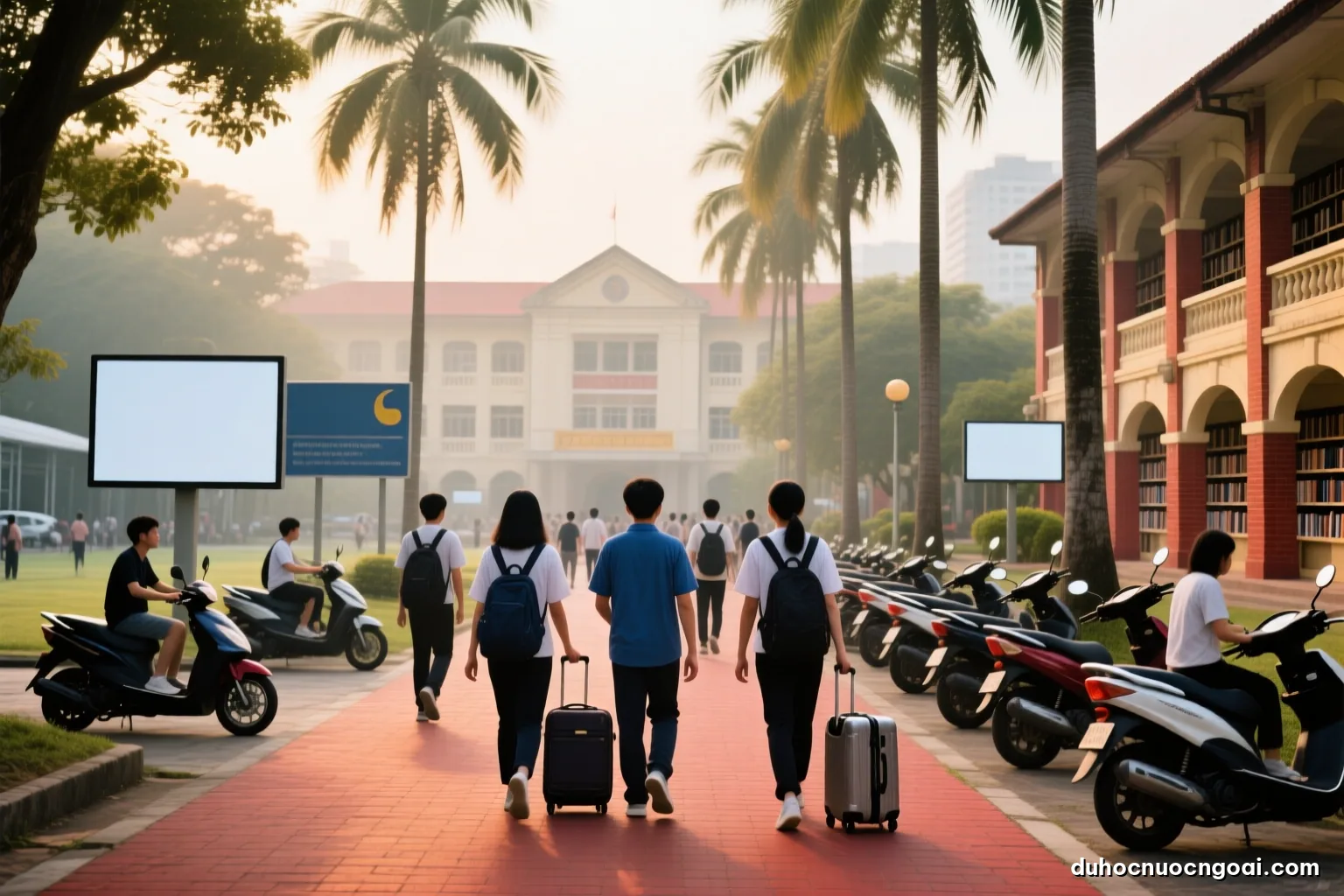
Degree study in China means applying to a bachelor's, master's or doctoral programme at a university permitted to admit international students, studying in Chinese (usually requiring an HSK certificate at the level the university sets) or in English (requiring IELTS or TOEFL), then applying for an X1 student visa with the admission notice and a JW201 or JW202 form, and obtaining a residence permit within 30 days of entry. The largest source of funding is the Chinese Government Scholarship managed by the China Scholarship Council (CSC).
China is a destination on a very large scale, with a multi-tiered university system, many scholarships and moderate living costs in most cities. Vietnamese students choose China mostly for scholarships, for engineering, economics and trade, medicine and pharmacy, or for the advantage Chinese gives them in working with companies from both countries. This article covers the structure of the university system, the types of scholarship, language requirements, the visa process, and what to weigh up before going.
China's university system and how to read a university's reputation
China has thousands of higher education institutions, but only those with permission may admit international students. In terms of reputation, people in China often refer to the C9 group of nine leading research universities: Peking, Tsinghua, Fudan, Shanghai Jiao Tong, Zhejiang, the University of Science and Technology of China, Nanjing, Xi'an Jiaotong and the Harbin Institute of Technology. The older labels "985" and "211" are still used in everyday speech, while the current policy since 2017 is "Double First-Class", which designates key universities and disciplines.
What is worth noting is that the list of key disciplines matters as much as the university's name. A university outside the top group may still have a very strong discipline, for example specialised universities for transport, petroleum, agriculture, foreign trade or medicine. When choosing, check whether your subject is a key discipline or a traditional strength at that university.
Geographically, the big eastern cities such as Beijing, Shanghai, Guangzhou, Shenzhen and Hangzhou are more expensive and more competitive; the southwestern provinces such as Guangxi and Yunnan are close to Vietnam, cheaper, and have many universities used to admitting Vietnamese students. The climate also differs enormously between the cold, dry north and the humid south, which you should factor in when choosing where to live for several years.
Common types of scholarship
Chinese Government Scholarship through the bilateral channel. For applicants nominated by the sending authority of their own country under an educational cooperation agreement; in Vietnam, selection announcements are usually published by the Ministry of Education and Training. The full scholarship usually covers tuition, on-campus accommodation, a monthly living allowance and health insurance.
Chinese Government Scholarship through the university channel. Some universities are allocated CSC scholarship quotas and select applicants who apply directly, mainly at graduate level. Applicants submit an application on the CSC system with the university's code, and also apply as the university requires.
Provincial and municipal government scholarships. Many local governments have their own scholarships to attract international students to universities in their area, with varying values and conditions. These are usually assessed through the university.
University scholarships. Tuition waivers or reductions, dormitory support or allowances, awarded on academic results. This is the most accessible source for those funding themselves in part.
Language study scholarships. There are scholarships specifically for short or one-year Chinese language courses; that is the language route, distinct from degree scholarships, and moving on to a degree requires a new application.
Language of instruction and entry requirements
Language requirements are set by each university and programme; the table below is only a reference framework to guide your preparation, and you must check the university's admissions page.
| Type of programme | Certificate usually required | Notes |
|---|---|---|
| Chinese-taught bachelor's | HSK, usually intermediate level or above | Medicine, literature and law may set higher levels |
| Chinese-taught master's and doctorate | HSK at a higher level than for a bachelor's | Some universities allow scholarship holders a one-year preparatory language course |
| English-taught programmes | IELTS, TOEFL or equivalent | Fewer in number, many in business, engineering and medicine |
| English-taught medicine | English, sometimes plus a science test | Only universities on the Chinese Ministry of Education's approved list |
Even when studying in English, students usually have to take Chinese as a compulsory subject, and daily life, clinical placements and company internships all require Chinese. Those planning a long stay in China should invest seriously in Chinese from the start.
The process from application to residence permit
The main intake is September; deadlines for the CSC scholarship and for many universities fall around the start of the year. The order below is a general framework.
- Choose a university and subject; check that the university may admit international students and that the programme is in the language and at the level you want.
- Prepare your diploma, notarised transcripts and translations; an HSK or IELTS certificate; a study plan; recommendation letters (for graduate study); a medical certificate on the form for foreigners; and a police clearance certificate if the university requires one.
- Apply to the university and, if applying for the CSC scholarship, submit on the CSC system through the correct channel (bilateral or university).
- Receive the Admission Notice and the JW201 form (for Chinese government scholarship students) or JW202 form (for all other cases) issued by the university.
- Apply for the X1 visa (for study of more than 180 days) at the Chinese diplomatic mission or visa application centre as instructed, with your passport, photos, admission notice, JW form and medical certificate.
- After arrival, register with the university, take a further medical check if required, and apply to convert your X1 visa into a residence permit at the local exit-entry administration within 30 days.
The JW201/JW202 form is an important document tied to one person and one university; if it is lost or damaged you must apply for a replacement through the university. Keep the original carefully together with your admission notice.
Daily life, part-time work and differences to prepare for
Student life in China revolves around international student dormitories, university canteens and mobile payment systems that cover almost all everyday spending. New students should open a local bank account early and link it to a mobile wallet as the university advises. Some online services familiar in Vietnam, such as Google and Facebook, cannot be accessed directly; prepare messaging apps that work in China so you can stay in touch with your family.
As for part-time work, international students are not free to take jobs as they are in some Western countries. Part-time work and off-campus internships must be approved by the university and noted on the residence permit by the exit-entry authority under the current rules. Working without permission can be penalised, even with deportation. So a study budget for China should assume no part-time income.
Another difference is the pace of study. Many Chinese-taught programmes have large classes, lecturers expect a lot of independent study, and final exams carry heavy weight. International students studying alongside Chinese students in Chinese-taught programmes often find the first year very demanding; subject-specific Chinese is a real challenge, not just an HSK certificate.
Budgeting for self-funded students or those with partial scholarships
A full scholarship covers most costs, but most students are self-funded or receive only a partial waiver. The list below helps families avoid missing any item when budgeting.
- Tuition as published by each university for international students, varying by subject and language of instruction; English-taught programmes and medicine are usually more expensive.
- Dormitory for international students, priced by room type; if you rent outside, you must register your temporary residence with the local police within the prescribed time.
- Health insurance, compulsory for international students, usually bought through the university each year.
- Residence permit and medical check fees on arrival and at renewal.
- Living costs, which differ greatly between first-tier cities and provincial cities; eating in the university canteen keeps costs down.
- Books, materials, travel and trips home for the summer break and Tết, when fares rise sharply in peak season.
Since you cannot count on part-time income, a self-funded budget should be prepared for the whole course, with a contingency for fluctuations in the exchange rate between the yuan and the dong.
Degrees, professional practice and questions to ask before you go
Degrees awarded by legally established Chinese universities can be considered for recognition in Vietnam under the current regulations of the Ministry of Education and Training. For licensed professions such as medicine, pharmacy and law, holding the degree is only the first step; to practise in Vietnam you must meet domestic licensing requirements such as practical training and competency assessments under the rules of each period. If you plan to study medicine in China and return to Vietnam as a doctor, research the licensing route carefully before choosing a university.
The first question to ask: is the university and programme on the list of those permitted to admit international students, especially for English-taught medicine? The second: what does the scholarship include, what conditions apply to keeping it, how long does it last, and does it include a preparatory language year? The third: what do you plan to do and where after graduating, and what advantage does this university's degree give that plan?
Finally, be wary of promises of a "guaranteed full scholarship" with high service fees. CSC and university scholarships are assessed by universities and the authorities; nobody can guarantee the outcome. If you would like someone to help you choose a university and subject and prepare your scholarship application through the correct channel, the Global Gate Pass advisory team takes bookings; the first session is free with no obligation.
Frequently asked questions
When do I apply for the CSC scholarship?
The CSC system and many universities usually open applications around the end of the previous year or the start of the year of entry, closing in the first quarter or early second quarter, for the September intake. The bilateral channel in Vietnam has its own announcement from the Ministry of Education and Training. Exact deadlines change by year and by university.
Can I study in China without HSK?
Yes, if you choose an English-taught programme, or enrol in a one-year preparatory language course before a Chinese-taught programme; some scholarships include this preparatory year. But to study a regular Chinese-taught programme, you almost always need HSK at the level the university requires.
What is the difference between JW201 and JW202?
Both are student visa application forms issued by the university. JW201 is for students on a Chinese government scholarship, JW202 for self-funded students or those with other scholarships. This form and the admission notice are mandatory documents when applying for an X1 visa.
Can international students in China work part-time?
Only with the university's approval and a note on the residence permit by the exit-entry authority under the current rules; working without permission can be penalised. So do not include part-time income in your financial plan for studying in China.
Can I study medicine in China and work as a doctor in Vietnam?
Your degree can be considered for recognition if the university is legal and the programme meets the regulations, but to practise you must meet domestic licensing requirements such as practical training and competency assessment under the current rules. Research this route carefully before choosing a university and programme.
Should I choose a university in a big city or in the provinces near Vietnam?
Big cities have many prestigious universities, internship opportunities and international networks, but higher costs and more competition. Provinces near Vietnam have lower costs, a familiar climate and many universities used to Vietnamese students. Choose by subject and career goal, not just distance.