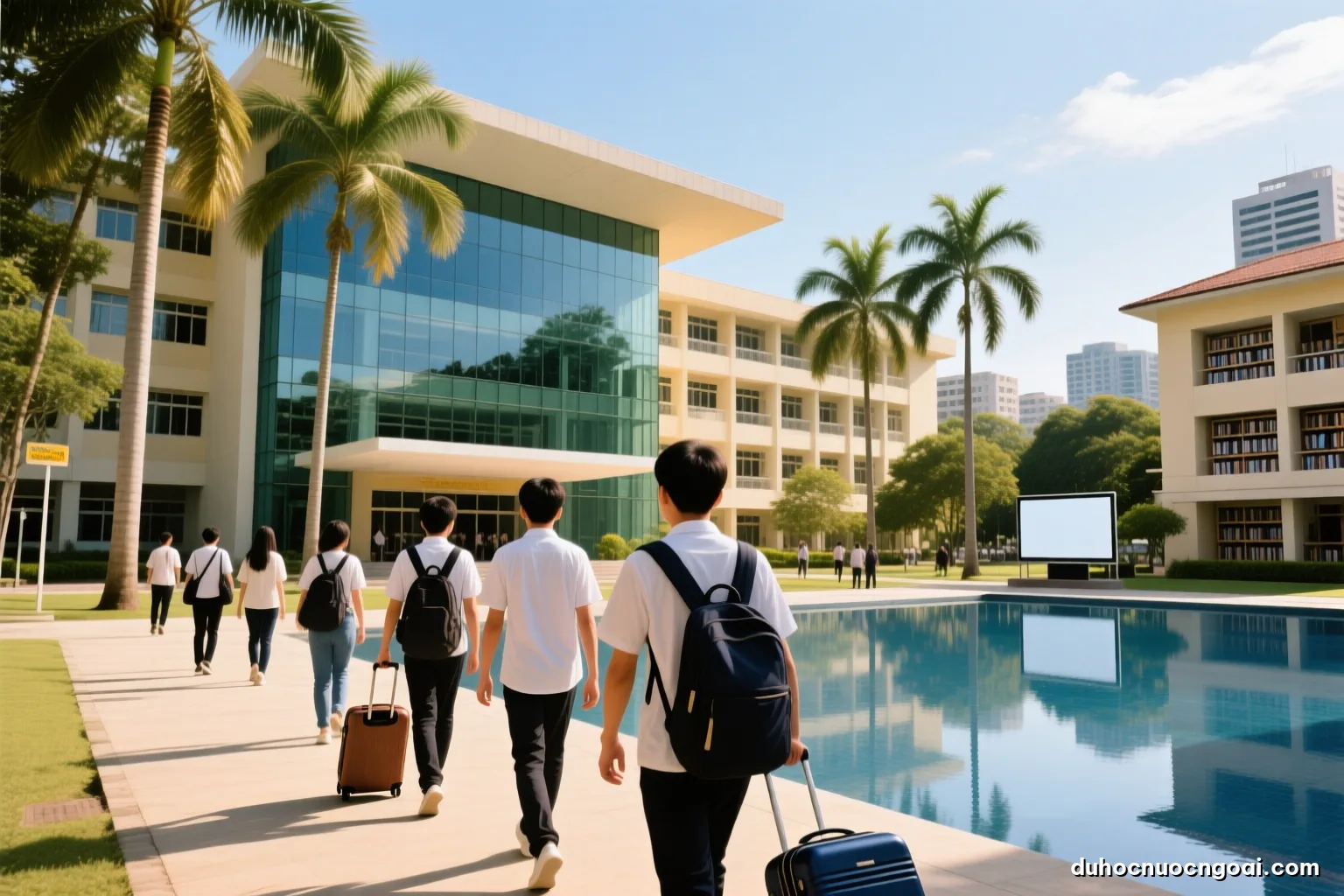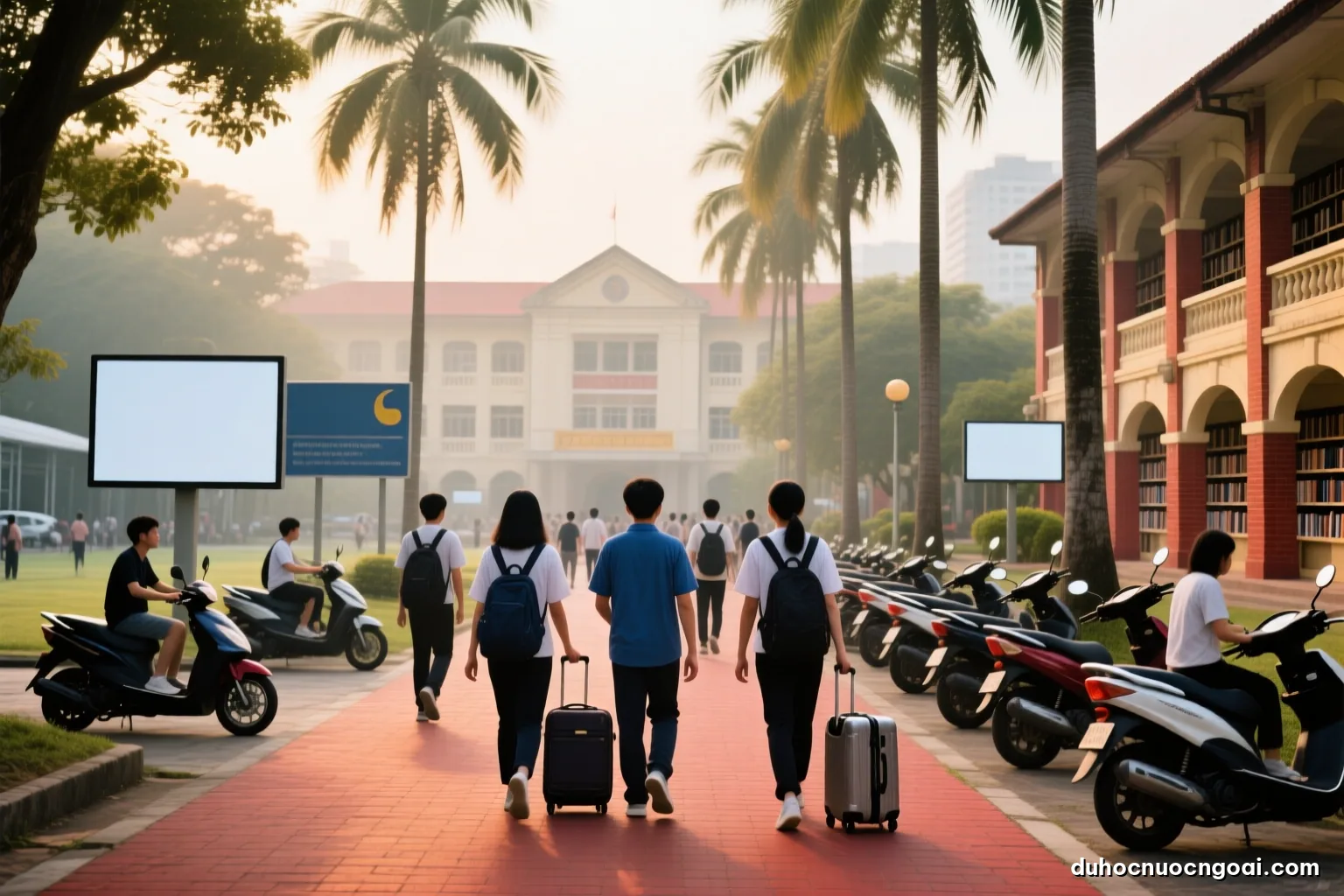
Degree study in Taiwan means applying directly to a bachelor's, master's or doctoral programme at a university as an international student, studying in Chinese (which requires a TOCFL certificate) or in English (which requires IELTS or TOEFL), then applying for a resident visa at the Taipei Economic and Cultural Office in Vietnam and obtaining an ARC residence card on arrival. The best-known scholarship is the Taiwan Scholarship from Taiwan's Ministry of Education, applied for through the representative office.
Taiwan appeals to Vietnamese students because it is close, moderately priced compared with the rest of East Asia, offers many English-taught graduate programmes, and is clearly strong in engineering, semiconductors, information technology and biomedicine. But it is also a market where many "study abroad" models are mixed together: short language courses, school–industry cooperation programmes, and work-and-study schemes. This article focuses on the degree route, how to choose a university and what to watch out for.
The landscape of Taiwanese higher education
Taiwan has a large number of universities relative to its population, divided into public and private institutions, comprehensive universities and universities of science and technology. Leading public universities such as National Taiwan University, National Tsing Hua University, National Yang Ming Chiao Tung University (NYCU, merged in 2021), National Cheng Kung University (NCKU), National Taiwan University of Science and Technology (NTUST) and National Chengchi University (NCCU) have good research reputations and are highly competitive.
Because of the falling birth rate, many universities, especially private ones in the regions, are short of students and actively recruit internationally. Some have had to merge or close in recent years. This cuts both ways: getting in is easier and university scholarships are more plentiful, but some institutions are of weak quality and there is a risk of a university running into difficulty mid-course. Checking a university's enrolment and financial situation is worth doing.
Graduate study is a strength for Vietnamese students: many master's and doctoral programmes in engineering, science and management are taught in English, and professors take students into their labs with research stipends. Bachelor's programmes in English exist but are fewer; most are taught in Chinese.
Studying in Chinese or in English
The choice of teaching language determines almost everything that follows: entry requirements, the number of programmes, how easily you integrate and find work. The table below compares them at the level of principle.
| Aspect | Chinese-taught programmes | English-taught programmes |
|---|---|---|
| Number of programmes | Very many, in every field | Fewer, concentrated at graduate level and in some fields |
| Entry certificate | TOCFL, at the level the university sets | IELTS, TOEFL or equivalent |
| Integration and part-time work | Much easier | Harder without Chinese |
| Working in Taiwan after graduation | Easier at most companies | Suits multinational companies and high-tech fields |
| Investment before leaving | One to two years of language study if starting from scratch | Mainly academic English |
Many people choose an English-taught programme but still study Chinese alongside, because daily life, part-time work and most job opportunities still require Chinese. If you plan a year of language study before your degree, language study is a separate topic; this article deals with the degree part.
Scholarships: the Taiwan Scholarship and other sources
Taiwan Scholarship. A scholarship from Taiwan's Ministry of Education for international students in degree programmes from bachelor's to doctorate, usually covering tuition support and a monthly living allowance for a set period. Applicants apply through Taiwan's representative office in their own country, usually early in the year, and must also apply to and be accepted by a university themselves. Detailed conditions, deadlines and values are announced each year.
University scholarships. Many universities have scholarships for international students: full or partial tuition waivers, sometimes with an allowance, awarded on academic results and maintained by grades each semester. This is the most common source and easier to obtain than government scholarships.
Research stipends. In engineering and science master's and doctoral programmes, the supervising professor may pay a stipend from a research project. Contacting a professor with a matching research direction in advance improves your chances of both admission and funding.
Short-term language scholarships. There are scholarships for short Chinese language courses, but that is the language route, not degree study; if you use one as a stepping stone, you need to plan your degree application separately.
The process from application to residence card
The main intake is September; some universities also have a February intake. International application deadlines for the September intake usually fall around the start of the year, depending on the university.
- Choose universities and programmes on Taiwan's study portal and the universities' websites; note deadlines, language requirements and documents.
- Prepare your diploma, transcripts, certified translations as required (usually needing verification through the representative office), language certificates, study plan, recommendation letters and proof of funds.
- Apply online to each university; apply for the Taiwan Scholarship in parallel if eligible.
- Receive the admission letter; prepare the resident visa application for study: admission letter, passport, photos, proof of funds, and a medical certificate on the prescribed form if required.
- Submit the visa application at the Taipei Economic and Cultural Office in Hanoi or Ho Chi Minh City; receive the visa and book your flight.
- After arrival, apply for the ARC residence card with the Immigration Agency within the prescribed time; buy insurance as the university requires until you are eligible for the national health insurance scheme.
Rules on document verification and medical certificate forms change over time; check the representative office's website when you prepare, rather than relying on a list from someone who went before you.
Budgeting for study in Taiwan
Costs in Taiwan are usually considered moderate for East Asia, but the gap between universities and cities is quite large. Public university tuition is usually lower than private; engineering and medicine usually cost more than social sciences. Universities publish tuition and estimated living costs for international students each year; this is the most reliable source for budgeting.
For living costs, Taipei is noticeably more expensive than Taichung, Tainan, Kaohsiung or smaller cities, mainly because of rent. On-campus dormitories are usually cheaper and safer than renting outside, and many universities give priority places to first-year international students. Eating in canteens and modest eateries keeps costs down, and getting around by metro, bus or public bicycle is convenient.
One-off costs to include: air fare, visa fee, ARC fee, medical check, insurance before you qualify for national health insurance, and a deposit if renting privately. When proving funds for the visa or a scholarship, use your family's real accounts and documents with a clear source; this is also how the family itself checks whether it can sustain the whole course.
Part-time work, insurance and staying on after graduation
International degree students who want to work part-time must apply for a work permit through the labour authority; the permit is time-limited and must be renewed. During term, working hours are limited to around 20 hours a week; during the winter and summer breaks the limit is relaxed. Working without a permit or beyond the hours can lead to fines and affect your residence status.
As for insurance, legally resident foreigners can usually join the national health insurance scheme after a period of continuous residence as prescribed; before that you need private insurance or insurance arranged by the university. This needs to be included in your first-year budget.
After graduating, international students can apply to extend their residence to look for work for a set period under the current rules. Taiwan has its own points system for foreigners who graduate from Taiwanese universities and apply for professional work permits, considering qualifications, salary, experience and language. Engineering, semiconductors and information technology have clear hiring demand, especially for those who know Chinese. Taiwan's talent-attraction policies change fairly quickly, so check the rules as graduation approaches.
What to watch out for
The Taiwan study-abroad market in Vietnam has many models all carrying the label "study abroad". The signs below help tell the degree route apart from riskier programmes.
- Programmes promising "study and work, with enough money to send home". In the past there have been cases reported by the Taiwanese and international press in which foreign students on school–industry cooperation programmes were made to work more hours than allowed. Degree study is for studying; part-time work is only a side activity within the legal limits.
- High service fees to "guarantee" a scholarship. Government and university scholarships are assessed by universities and the authorities; nobody can guarantee the outcome.
- Universities not on the list of those allowed to recruit internationally, or struggling to enrol students. Check the Taiwanese Ministry of Education website and news about the university.
- Entering on a short-term visa and then "converting" on the spot. Degree study requires the correct resident visa for study; workarounds can damage your residence record later.
- Translations and verification through unclear intermediaries. Diplomas and transcripts must be verified through the proper procedure; problematic documents can lead to your admission being cancelled.
If you would like someone to help you tell degree programmes apart from other models and review your scholarship application, the Global Gate Pass advisory team takes bookings; the first session is free with no obligation.
Frequently asked questions
Do I need to know Chinese to study in Taiwan?
Not if you choose an English-taught programme, in which case you need IELTS or TOEFL. However, most programmes, especially at bachelor's level, are taught in Chinese and require TOCFL. Even if you study in English, knowing Chinese makes daily life, part-time work and job hunting much easier.
Where and when do I apply for the Taiwan Scholarship?
Vietnamese applicants apply through the Taipei Economic and Cultural Office in Hanoi or Ho Chi Minh City, usually around the start of the year for the September intake. You must also apply to the university yourself in parallel. Deadlines and conditions are announced each year, so follow the office's announcements.
Does the Taiwan Scholarship cover all costs?
It usually covers tuition support up to a cap and a monthly living allowance, but not necessarily every item such as air fares, insurance or other fees. Values and conditions for keeping it are announced each year; budget for the difference.
How many hours can international students in Taiwan work?
Degree students must have a work permit. During term the limit is around 20 hours a week; during the winter and summer breaks it is relaxed. The rules may be adjusted, so check with the university's international student office and the labour authority.
Is a Taiwanese university degree recognised in Vietnam?
Degrees awarded by legally established higher education institutions in Taiwan can be considered for recognition by Vietnam's Ministry of Education and Training under the current regulations. Choosing a university recognised by Taiwan's Ministry of Education and studying in a regular degree programme makes recognition easier.
Should I choose Taiwan, Korea or Japan?
Each has its own strengths: Taiwan has moderate costs and many English-taught graduate engineering programmes; Korea and Japan have large government scholarship schemes and broad job markets. Choose by subject, the language you want to invest in and your career plan, not by advertising.