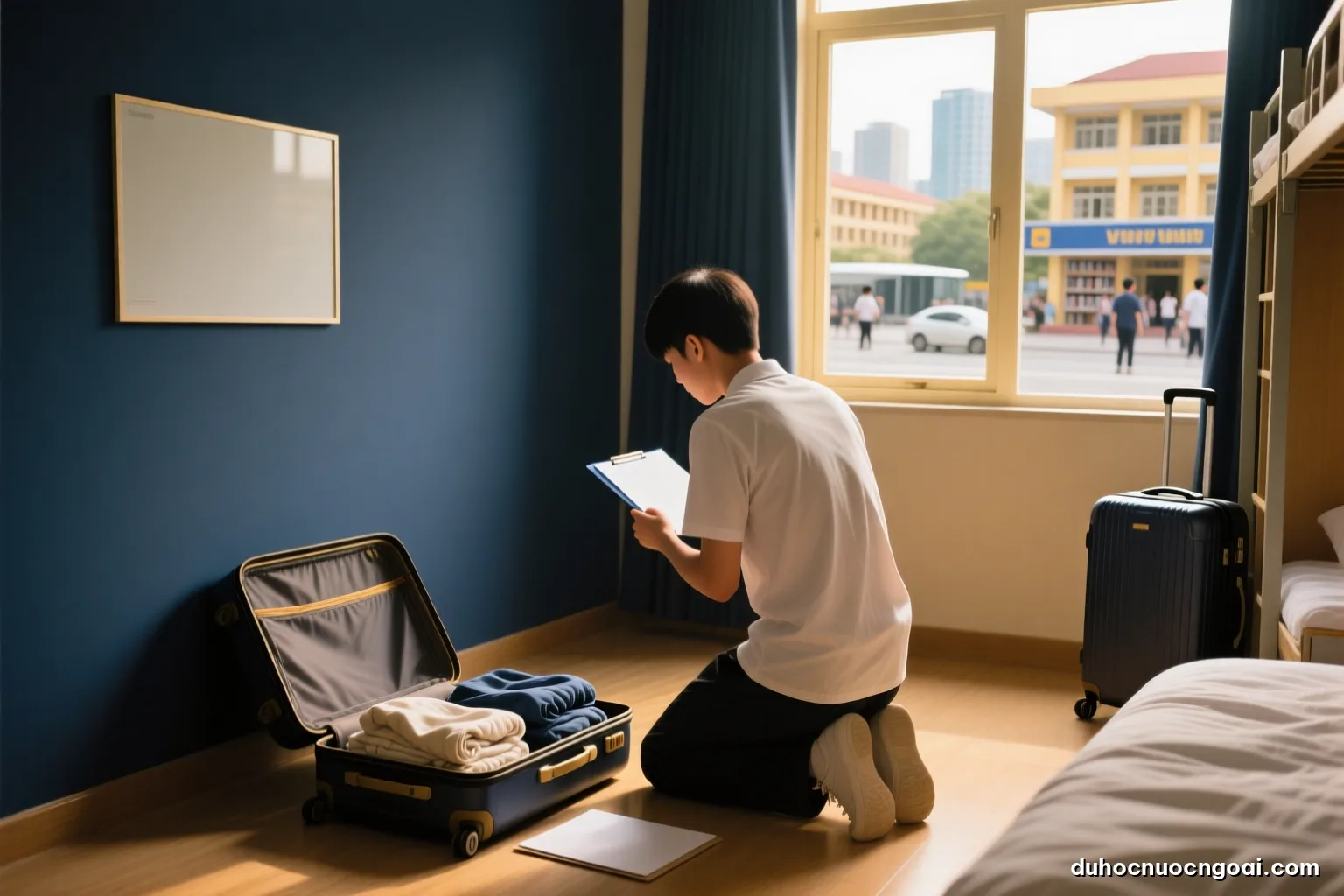
Packing well for study abroad means splitting your things into three groups: documents and money carried on you in your hand luggage, essentials to last roughly the first two weeks, and everything else to buy once you arrive. Before you fill a suitcase, read the baggage rules of the airline on your specific ticket and the list of banned and declarable goods published by the customs and biosecurity authorities of your destination — food, medicine and cash are the three groups that most often cause trouble.
Most first-time international students bring far too much: duvets and pillows, pots and pans, whole boxes of instant noodles, clothes for four seasons. The result is excess baggage fees, dragging two heavy suitcases through train stations, and then discovering that those things could be bought at the destination for not much more. On the other hand, the things that are hard to replace — original documents, prescription medicine you take regularly, spare glasses — are often forgotten or put by mistake in checked baggage. This article follows an order of priority: what must not be lost, what must not be brought, and only then clothes and household items.
Group 1: documents and money — always on you
This group goes in your handbag or backpack and is never checked in. If your suitcase is lost, you can still enter the country, enrol and rent a place to live. Each item should exist as a paper copy and a scan stored in the cloud, with a copy also sent to your parents.
- A valid passport and the matching visa or approval document (the I-20 for the US, the study permit approval letter for Canada, the COE for Japan, the eVisa confirmation or share code for the UK…).
- Your offer letter and proof that tuition fees and deposits have been paid — border officers may ask which university you are attending and where you will live.
- The financial documents used for your visa application, your health insurance certificate and proof of accommodation (a residence hall contract, a homestay letter or the address of a hotel for the first few days).
- Original diplomas, school records and transcripts, plus translations: universities often check originals during enrolment week; some countries need them later when you change visa.
- Passport photos in the size used by your destination, a few of them — for your student card, transport card and residence documents.
- Money: one international card in your own name (a debit card or a supplementary credit card), a backup card kept somewhere else, and a little local currency in cash for the first few days. If you carry a large amount of cash, check the declaration threshold at both the Vietnamese border and your destination.
- Prescriptions and a doctor's letter if you are bringing prescription medicine, with the active ingredients written in English.
A small tip that saves many situations: print a sheet with the address of your first accommodation, a contact number at the university and your booking numbers, and keep it in your wallet. Your phone may run out of battery exactly when you are standing at the customs desk after a long flight.
Group 2: things you must not bring or must declare
Every country has its own lists of banned and declarable goods, published on the website of its customs or biosecurity authority. The general principle is the same everywhere: countries with large agricultural sectors or island ecosystems are stricter about food. Australia and New Zealand are known for strict biosecurity: most food, seeds, meat products, eggs and dairy must be declared, and failing to declare can bring an on-the-spot fine even for a single dried snack. The US bans most meat products and restricts many fresh fruits. Japan and South Korea also check meat, eggs and animal products.
For food, the safe rule is: if in doubt, declare it. Declaring does not mean it will be confiscated — officers inspect it and let you keep it if it is allowed. What causes trouble is hiding things. The items families often pack, such as Chinese-style sausage, pork floss, dried beef jerky, fish sauce, fresh fruit and vegetable seeds, are in the high-risk group; sealed dry spices, tea and roasted coffee are usually easier but should still be declared.
Medicine is the second group. Some active ingredients sold over the counter in Vietnam are controlled in other countries — for example, Japan restricts cold medicines containing stimulant-type ingredients such as pseudoephedrine, and many sedatives and strong painkillers require an import licence. What to do: bring enough for a few months, keep it in the original labelled packaging with the prescription, and check the website of the health authority or embassy of your destination if the medicine is a psychotropic or narcotic.
Finally, there are the items banned on the plane: liquids in hand luggage are limited per bottle, power banks must go in hand luggage rather than checked baggage, and knives and scissors must be checked in. The exact rules depend on the airline and airport, so read the ones on your own ticket.
Group 3: clothes and household items — bring little, buy later
The questions that decide whether an item is worth bringing: is it hard to buy at your destination, is it much more expensive there, and do you need it in the first two weeks? The table below covers the items people ask about most.
| Item | Bring it? | Why |
|---|---|---|
| Everyday clothes | Enough for one to two weeks | They can be washed; buy more to suit the real climate and the style of your new friends |
| A heavy winter coat | Usually not | Coats bought in Vietnam are often not warm enough for North American or Northern European winters; buying locally gets you the right kind. Bring a medium jacket to wear when you land |
| Good walking shoes | Yes | You walk a lot in the first days; broken-in shoes prevent blisters |
| Duvet, pillow, rice cooker | Usually not | Bulky; residence halls often offer a bedding pack or you can buy them at the supermarket; a rice cooker must match the local voltage |
| Electronics (laptop, phone) | Yes | Carry them in hand luggage; check that your phone works on the destination's frequency bands |
| Plug adapters | Yes, one or two | The US, Canada and Japan use flat pins; the UK uses three square pins; Australia and New Zealand use angled pins; most of Europe and South Korea use round pins |
| Spare glasses and contact lenses | Yes | Eye tests and glasses are expensive in many countries and need an appointment |
| Dry spices, food from home | A little, sealed, declared | Asian supermarkets in big cities stock almost everything; food from home is only to ease homesickness in the first days |
| Áo dài, traditional clothing | One set if you like | Useful for cultural festivals, graduation and Vietnamese student association events |
Voltage is an often-forgotten detail: Vietnam uses 220V, the US and Canada about 120V, and Japan 100V. Most laptop and phone chargers accept 100–240V automatically, so you only need a plug adapter; hair dryers, rice cookers and irons brought from Vietnam to Japan or the US may run weakly or break.
Checked and hand luggage: how to split them so you do not lose your first day
Your carry-on backpack is a "48-hour survival kit". Besides documents, it should hold a change of clothes, small-size toiletries, the medicine you take, chargers, a plug adapter and your laptop. If your suitcase arrives a day or two late — common with connecting flights — you can still get on with life as normal.
Read the baggage rules on your ticket, not what people tell you. On the same airline, different fare classes have different numbers of bags and weight limits; a connecting leg operated by another airline may apply stricter rules. Some airlines offer extra allowance for students who show their offer letter — ask before booking.
Weigh your suitcase at home and leave some space. A handheld luggage scale is very cheap and spares you from repacking at the check-in desk. Leave about two to three kilograms for things you buy at your destination or gifts when you come home.
Mark your suitcase and photograph what is inside. Attach a name tag with your email and tie on a strip of brightly coloured fabric; take photos of the suitcase and its contents. If it goes missing, the photos help you file a report quickly and serve as evidence when you claim compensation from the airline.
Do not carry things for other people. Not even for acquaintances who ask you to "take a little gift parcel to my child over there". You are legally responsible for everything in the suitcase checked in under your name. If you agree, open it yourself, check it and declare everything.
A week-by-week packing timeline before your flight
Leaving everything to the last two days is the most common reason people forget documents or bring banned items. The timeline below assumes you already have your visa.
- Four weeks before: see the dentist, have an eye test and get spare glasses; ask your doctor for a long-term prescription and a letter listing the active ingredients in English; check that your passport and bank cards are still valid.
- Three weeks before: read your destination's customs and biosecurity declaration lists; read the baggage rules on your ticket; list what the university or residence hall already provides.
- Two weeks before: scan every document, store copies in the cloud and print paper copies; prepare your international card and a little local cash; buy plug adapters.
- One week before: do a trial pack, weigh it and take things out; prepare your carry-on backpack using the "48-hour survival" list.
- The day before you fly: check your documents against the printed list, fully charge your devices, and send your parents your flight details and first address.
When you arrive, the arrival declaration (paper or electronic, depending on the country) asks directly whether you are carrying food, medicine or cash above the threshold. Answer honestly according to what is actually in your suitcase — that is why you need to know exactly what you packed.
Things to buy at your destination instead of bringing
The "buy later" list is usually longer than you think. Bed sheets, towels, hangers and basic kitchenware are available in budget supermarkets or second-hand shops near campus; many universities also hold second-hand markets at the start of the year where final-year students sell whole sets of household items for a token price. Vietnamese student associations in many cities have swap groups — ask before you fly and you may inherit a rice cooker, an iron or a heater from the previous intake.
Personal items such as shampoo, toothpaste and common cosmetics bought locally keep your suitcase light and suit the local water and climate better. What is worth bringing are the products you are fussy about — sunscreen, a cleanser for sensitive skin — enough for a few weeks while you look for a replacement.
Do not bring textbooks: programmes abroad use different course materials, and the university library often has electronic copies. The same goes for paper dictionaries. What is worth bringing is a few Vietnamese books you love to read when you miss home — they weigh less on the scales than you would think, and more for your spirits than you would expect.
Frequently asked questions
Should I bring instant noodles and dried food from Vietnam?
You can bring a little to make the first days less unfamiliar, but it must be sealed and declared on arrival. Noodles whose seasoning sachets contain meat may be restricted in some countries. In big cities, Asian supermarkets sell almost all of these, so bringing a whole box is unnecessary.
How much cash is sensible to bring when going to study abroad?
Only enough for about the first week: transport from the airport, food, a SIM card and a few household items. Most spending after that goes through your card or a bank account opened locally. Carrying a lot of cash risks theft and may have to be declared if it exceeds the threshold of Vietnam or your destination.
Can I bring traditional Vietnamese or Chinese herbal medicine?
It is very difficult. Herbs, extracts and pills with unclear ingredients are often held at the border in countries with strict biosecurity such as Australia and New Zealand, and may contain ingredients banned in other countries. If you really need them, choose packaged products with a clear ingredient label and declare them in full.
What should I do if my suitcase is lost when I arrive?
Go straight to the airline's lost baggage desk inside the airport before you leave, file a report with your baggage tag and photos of the suitcase, and get a reference number. Give your accommodation address so the airline can deliver it. Keep receipts for the essentials you have to buy while you wait, because many airlines or travel insurers refund part of the cost.
Should I bring a laptop from Vietnam or buy one abroad?
If you already have a laptop that works well, bring it in your hand luggage. Some universities offer student discounts on new computers bought locally, but in the first week you need a computer straight away to register for courses, so do not arrive without one. Check that the charger accepts 100–240V.
Should I bring a warm duvet from home?
Usually not. A duvet takes up a lot of suitcase space, while residence halls offer bedding packs or supermarkets near campus sell them at ordinary prices. If you arrive in the cold season and cannot buy one on your first night, ask your accommodation in advance whether they provide a temporary duvet.