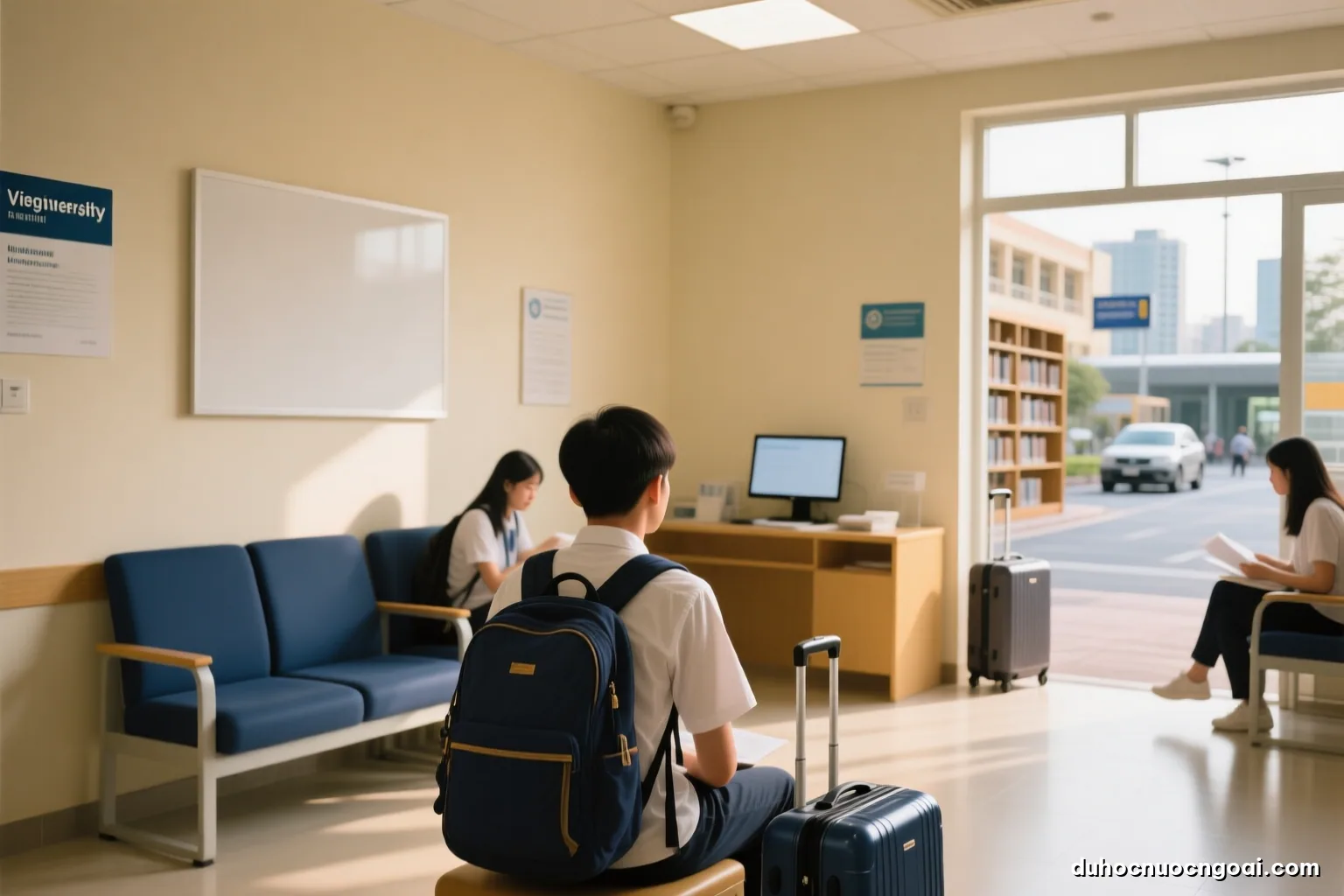
When you fall ill while studying abroad, a sensible order is: for minor illness, call or visit the university health centre or the family doctor you are registered with; if you need to be seen the same day but it is not dangerous, use a walk-in clinic or the country's medical advice line; only go to the emergency department or call the emergency number when there are signs of a life-threatening condition. For this system to work, you need to have done three things in your first week: activated your health insurance, registered with a doctor or the health centre, and saved the emergency number along with the address of the nearest facility.
In Vietnam, many people are used to going straight to hospital or buying medicine at a pharmacy when they feel unwell. In most popular study destinations, the health system works in tiers: a front-line doctor sees you first and refers you to a specialist when needed, and antibiotics and many other medicines are only sold with a prescription. Understanding how this works helps you get seen faster, avoid surprise bills and not miss the moment when you genuinely need emergency care. Insurance costs are covered in a separate article; this one is about how to use it.
Four ways into the health system and when to use each one
The names differ by country, but the structure is quite similar. Choosing the right entry point gets you treated faster and avoids crowding the emergency department with non-emergency cases, where you may have to wait for hours.
| Entry point | Use it when | Example names | Note |
|---|---|---|---|
| University health centre | Ordinary illness, vaccinations, health advice, a sick note to request an extension | Student health center (US), on-campus health services at many universities in Australia and Canada | Usually cheap or already included in student fees; many require an appointment |
| Family doctor | Non-urgent illness, long-lasting conditions, referrals to specialists, prescriptions | GP in the UK, Australia, New Zealand and Canada; Hausarzt in Germany | In the UK you must register with a GP surgery near where you live; do it in your first week |
| Walk-in clinic, telephone advice | You need to be seen the same day but it is not life-threatening: high fever, a sprain, a minor infection | Urgent care, walk-in clinic; the NHS 111 line in the UK | Cheaper and faster than the emergency department; some require you to pay first and claim from your insurer |
| Emergency department, emergency number | Difficulty breathing, chest pain, heavy bleeding, serious injury, seizures, loss of consciousness, intent to self-harm | Emergency, A&E; 911 in the US and Canada, 999 in the UK, 112 in Germany and the EU, 000 in Australia, 119 in Japan and Korea | Do not hesitate to call when there are danger signs; costs are dealt with later |
If you are not sure which entry point your condition belongs to, many countries have free medical advice lines that answer 24 hours a day, and university health centres also have out-of-hours numbers. Save these numbers on your phone together with the address of the nearest facility as soon as you move in.
How the systems in popular destinations differ
UK. Once they have paid the immigration health surcharge with their visa application, international students use the national health service almost like residents. What you need to do is register with a GP surgery near your home. In England, prescriptions carry a fixed charge per item, while Scotland, Wales and Northern Ireland are free; dental and eye care are charged separately.
US. Most universities require you to buy the university's health insurance or an equivalent plan. Medical bills in the US can be very large, and your insurance card only reduces them if you understand the deductible, co-payment and provider network in your policy. The university health centre is usually the cheapest and safest place to start.
Australia. Students on a student visa must maintain Overseas Student Health Cover for the whole duration of their visa. You can see a GP just like residents; some clinics charge only what your insurance pays, while others charge a gap on top. Ask before your appointment.
Canada. It varies by province: some provinces let international students join the provincial health insurance plan after a waiting period, others require you to buy the university's plan. Check your university's website for the policy that applies where you study.
Germany, Japan, Korea. Students join the country's health insurance system; in Japan, National Health Insurance usually covers most of the cost of a consultation and the patient pays the rest. Bringing your insurance card to every appointment is what ensures you are charged the correct amount.
Read your insurance policy before you get ill, not after
The best time to understand your insurance is a free evening in your first week, not when you have a fever at the clinic reception desk. Take your policy or the benefits summary and find the answers to five questions: how much does a GP visit cost; how are emergency care and hospital stays covered; are prescriptions covered; is there a list of in-network providers, and what happens outside the network; are dental, eye and mental health care included?
Common terms worth remembering: the deductible is the amount you pay yourself each year before the insurance starts paying; the co-payment is a fixed amount you pay for each visit; co-insurance is the percentage you bear after you have passed the deductible. Two plans with the same premium can differ completely on these three figures. Some plans require you to pay upfront at the clinic and then submit the bill to claim it back; keeping every receipt, prescription and medical document is essential.
Install your insurer's app if there is one, save a photo of your insurance card on your phone and send a copy to your parents. If you have a pre-existing chronic condition — asthma, severe allergies, a thyroid condition, heart disease — ask carefully about the pre-existing conditions clause, because some plans limit cover for these conditions.
What a doctor's appointment looks like
For anyone seeing a doctor abroad for the first time, the process below helps keep the appointment short and focused:
- Book an appointment. Phone, use the app or the clinic's booking page. Briefly describe the main symptoms, when they started and how severe they are. If you are asked whether you need to be seen urgently, answer honestly.
- Prepare in advance. Write down your symptoms in chronological order, the medicines you take (including medicines brought from Vietnam), drug allergies and past illnesses. Write them in the local language or English if you are not yet confident speaking.
- Ask for an interpreter if needed. Many health systems offer free telephone interpreting for patients who are not fluent in the language. Ask when you book. Do not let friends who do not know the medical terms translate important things for you.
- Check you have understood. Before you leave, repeat back in your own words the diagnosis, how to take the medicine and when to come back. Ask which signs mean you must go to the emergency department.
- Collect your medicine and documents. Take the prescription to a pharmacy; ask the pharmacist to explain if the medicine's name differs from what you are used to at home. Ask for a medical certificate if you need to submit one to the university for an extension or an authorised absence.
Doctors in many countries rarely prescribe antibiotics for ordinary colds and flu and often advise rest and monitoring. That is practice in line with professional guidance on appropriate antibiotic use, not the doctor being careless. If your symptoms get worse or last longer than expected, go back.
Medicine, dental care and the costs people forget
In most study destinations, antibiotics and many medicines that are common in Vietnamese pharmacies are only sold with a prescription. Over-the-counter medicines for colds, headaches and mild allergies can be bought at pharmacies and supermarkets; the pharmacist is a free and reliable source of advice and can tell you when you should see a doctor. Do not take medicine someone else gives you, even your roommate, and do not ask for antibiotics to be sent from Vietnam to take on your own.
Dental care is what surprises international students most. In quite a few countries, basic student insurance does not cover dentistry or only covers dental emergencies, while dental treatment abroad is often expensive. The practical advice is to have a check-up and any treatment done in Vietnam before you fly, and to consider buying extra dental cover if your course is long.
Glasses and contact lenses should also be prepared with spares from home, along with your prescription. People with chronic conditions should bring a summary of their medical history in English from their doctor in Vietnam, which helps the new doctor continue treatment without starting from scratch. Vaccinations required by the university should be done before you leave; the university sends the specific list.
Situations that need emergency care straight away, and what to do afterwards
Do not wait until morning if there are danger signs. Difficulty breathing, chest pain or tightness, weakness on one side of the body, sudden difficulty speaking, high fever with a stiff neck or rash, head injury, poisoning, a severe allergic reaction, or intent to harm yourself: call the emergency number or go to the emergency department. The call handler will guide you step by step while you wait.
Tell someone. Message a flatmate or a close friend before you go and, if possible, ask them to come with you. Save emergency medical information on your phone: your blood group if you know it, allergies, medicines you take, an emergency contact.
After emergency care: tell the university and your insurer. Contact the international student office for academic support if you have to take a long break, and notify your insurer promptly within the time limit in your policy. Keep every discharge document and bill.
Tell your family calmly. Parents far away worry more than the person involved. Let them know once you have clear information: where you are, how you are, and who is helping you. The Global Gate Pass advisory team often advises families to agree before departure on a "plan for when you are ill": who contacts whom, and where the documents are kept.
Frequently asked questions
What should I do if I get ill before registering with a GP?
Use the university health centre, a walk-in clinic or the country's medical advice line. In the UK, you can still be seen for urgent treatment and can call the non-emergency line for advice. Once you have recovered, register with a surgery near your home straight away so you are not caught out next time.
Does my study abroad insurance cover me when I go back to Vietnam for the summer?
Usually not, or only to a very limited extent. Most international student insurance is only valid in the host country. If you are going back to Vietnam for a long time, consider domestic insurance or travel insurance for that period, and read the terms before you fly.
Should I bring antibiotics from Vietnam just in case?
No. Many countries restrict bringing in prescription medicines without a doctor's prescription, and taking antibiotics on your own without proper indication contributes to drug resistance and can mask an illness that needs to be examined. Bringing ordinary medicines, plus the medicines you are being treated with together with the prescription and a doctor's letter, is enough.
Will I be turned away from a US emergency department if I have no money?
Under US federal law, hospitals with emergency departments that accept Medicare patients must provide a screening examination and stabilise an emergency condition regardless of ability to pay. The bill will come later, so full insurance is still essential. If you receive a large bill, contact your insurer and the hospital's billing office to ask about adjustments.
Can I get a sick note to defer an exam?
Most universities have an extenuating circumstances or extension procedure for illness, which requires a certificate from a doctor or medical facility within a set time. Read your university's rules at the start of term and see a doctor at the time you are ill, because a note requested afterwards is often hard to get accepted.
How do I see a doctor if my English is not very good?
Write down your symptoms, the medicines you take and your allergies on paper or your phone; ask the clinic about free medical interpreting, which many systems offer by telephone. Learning some basic words for symptoms beforehand will make you more confident, but do not hesitate to ask the doctor to speak slowly or repeat things.