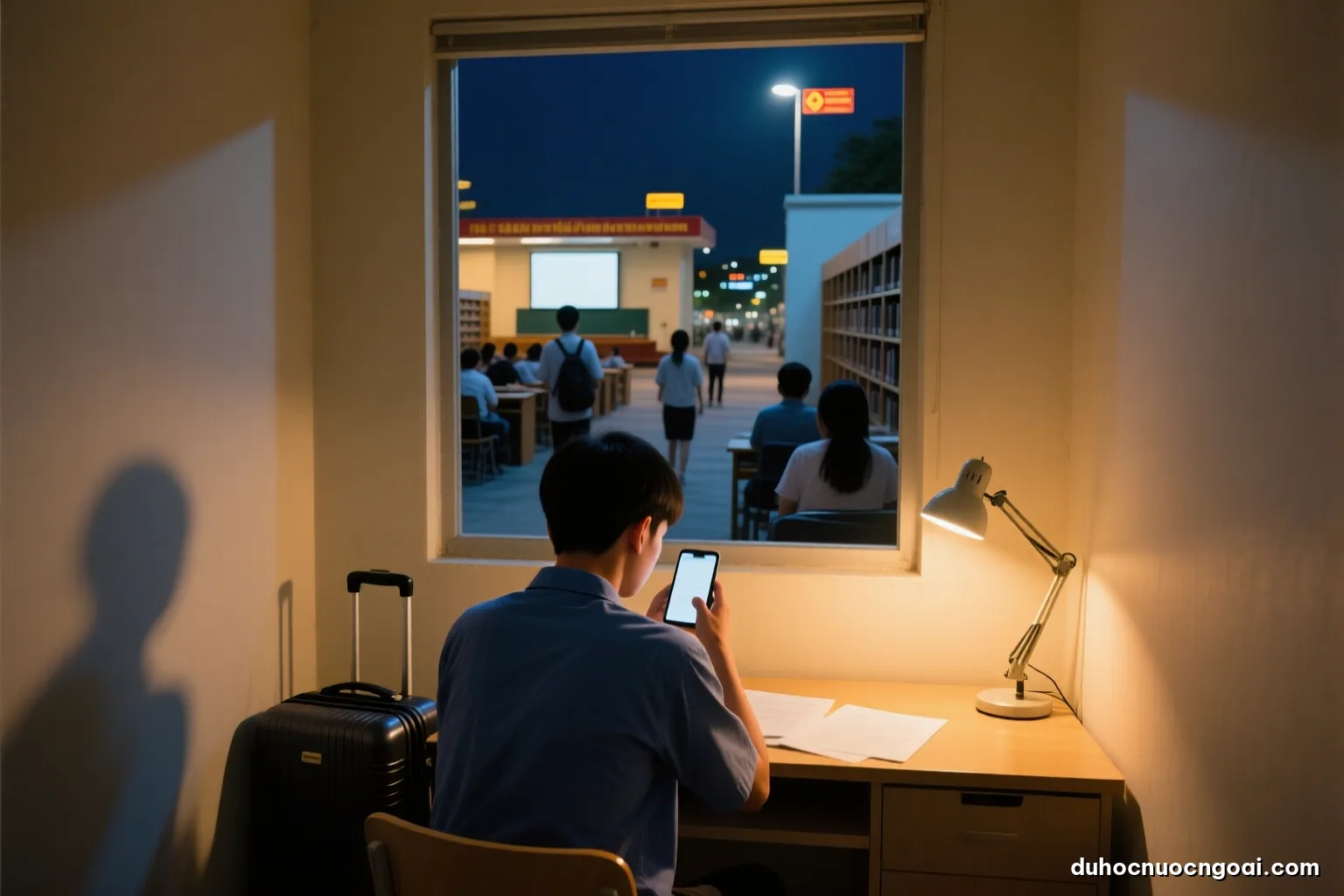
For your first year abroad, halls of residence or student housing run by the university are usually the safest choice: you can book them from Vietnam, the contract runs for the academic year, they are close to classes, and there are staff on hand and people your own age. Homestay suits students under 18 or anyone who wants to practise the language with someone looking out for them. Renting privately (alone or in a shared flat) is cheaper in many cities but is best left until your second year, when you know which areas are safe, can read a local tenancy agreement and have friends to share with.
Choosing where to live is one of the decisions that most shapes your first year: it determines how long it takes you to get to class, whom you get to know, how you eat, and whether there is anyone to knock on your door when you are ill. It is also the second-largest expense after tuition. This article compares the three common types of accommodation, explains how to book from Vietnam, the clauses to read carefully in a tenancy agreement, and the signs of rental scams aimed at people booking from far away.
Comparing the three common types of student accommodation
The names vary by country — halls of residence in the UK, dorms in the US, student residences in Canada, Studentenwohnheim in Germany, ryō in Japan — but they can be grouped into three types according to how they work.
| Criterion | Halls / student housing | Homestay | Private rental |
|---|---|---|---|
| Booking from Vietnam | Easy, through the university portal or a student housing company | Through the university or a homestay agency | Hard to do safely without viewing; high risk of scams |
| Contract | For the academic year, standard terms | Weekly or monthly, with house rules | Usually 6–12 months, terms set by local tenancy law |
| Meals | Some include a meal plan, some are self-catered with a shared kitchen | Usually includes some meals | Entirely up to you |
| Electricity, water, internet bills | Usually included in the rent | Usually included | Usually paid by you; you have to set them up yourself |
| Privacy and freedom | Medium | Lowest; you follow the host family's routine | Highest |
| Chances to make friends | High, lots of shared activities | Centred on the host family | Depends on your flatmates |
| Who it suits | First-year students, new arrivals | Secondary school students, those who need support | Students from second year on, people who know the area |
At many US universities, first-year students are required to live in residence halls; many universities in the UK, Australia and Canada give priority to or guarantee a place for first-year international students who apply on time. In Germany, Studierendenwerk halls are cheap but waiting lists can last many months; in Japan and Korea, university dormitories have a limited number of places. Reading the university's accommodation page as soon as you receive your offer is the first thing to do.
Halls of residence: what to know before you apply
The application deadline is usually earlier than you think. Many universities open their housing portal as soon as you accept your offer, and rooms are allocated in order of application or by a deadline. A few weeks' delay can leave only the most expensive rooms, or push you into private housing.
There are several room types, with significant price differences. Twin rooms, single rooms with shared bathrooms, single rooms with a private bathroom (en-suite), studio flats. Twin rooms are the cheapest and help you make friends quickly, but whether they suit you depends on your personality. State your preferences and living habits clearly on the application form.
Read the contract dates carefully. A halls contract may cover only term time, not the winter or summer breaks. If you are staying over the holidays, ask in advance whether you can extend and at what price, so you are not left without a place to live in December.
Compulsory or optional meal plans. Some residence halls in the US require you to buy a meal plan. A meal plan is convenient if you do not cook but can cost more than cooking for yourself; ask what levels are available and whether you can change mid-term.
Private student housing is a separate category. In the UK, Australia and many European cities, companies build blocks specifically for students, which can also be booked online. They can be good, but the contract is a commercial agreement with the company, not with the university. Check the cancellation policy in case your visa is refused before paying a deposit.
Homestay: when to choose it and how
A homestay means living with a local family, usually with your own room, some meals and life according to the household's routine. For secondary school students it is almost the default choice in English-speaking countries, and it often comes with a guardian as required by the school or the destination country. For university students, homestay suits those who want support during the first few months, want to practise the language every day, or are studying somewhere the residence halls are full.
The quality of a homestay depends heavily on the specific family. The way to reduce the risk is to go through an agency that vets families — the university accommodation office or a homestay company recommended by the university — rather than finding one yourself through social media. Ask clearly before accepting: how far the home is from the university and how you get there, which meals are provided, whether there is a curfew, whether you can use the kitchen and do laundry, whether there are pets or young children, and whether friends can visit.
Once you have moved in, speak up early when something is not right — food that does not suit you, a room that is too cold, mismatched schedules. Most homestay conflicts come from both sides keeping quiet until things become too tense. If you feel unsafe, contact the agency or the university's international student support office immediately; they have a procedure for changing families.
Private rentals: reading the contract and understanding deposits
The deposit is your money, and the law protects it. In many countries, a rental deposit must be lodged with a scheme or intermediary body rather than staying in the landlord's pocket: the UK has deposit protection schemes that landlords must register with within a legal time limit, and Australian states have authorities that hold the bond. Ask the landlord where the deposit will be held; a vague answer is a warning sign.
A condition report on the day you move in. Take photos and video of every room, every scratch, stain and broken item on the day you move in, and email them to the landlord or management company so there is a date stamp. This is your evidence when you move out and claim your deposit back.
Who pays the bills, who does repairs. The contract should state clearly who pays for electricity, water, gas, internet, rubbish collection or local residence tax, and which repairs the landlord must carry out. In some countries students are exempt from certain local taxes if they submit a certificate from their university.
Early termination clauses. If you have to return home midway, change university or fail a term, how can you get out of the contract and how much will it cost? A shared tenancy can make tenants jointly liable — if one person leaves, the others have to cover their share.
Country-specific features. Japan has key money (reikin), which is not refunded, and usually requires a rent guarantee company; Korea has rentals with either a large deposit or a small deposit plus monthly rent; in Germany shared flats (WG) are common and landlords often ask for proof of income or finances. Read your university's housing guidance for international students before signing.
Signs of rental scams aimed at people booking from abroad
International students are a favourite target of rental scams because they have to find housing while still in Vietnam, cannot view in person and are often in a hurry. The script repeats itself with a few variations:
- A price unusually low for the area, hotel-quality photos, posted on social media or classified ad sites.
- The "landlord" is abroad so cannot show you the property, and offers to post the keys after you transfer the money.
- Pressure to pay the deposit urgently because "lots of people are asking", by personal bank transfer, e-wallet or an international money transfer service that is hard to trace.
- No contract, or a sketchy contract without the landlord's legal name and address.
- Requests for photos of your passport and personal documents before you have even viewed the property.
How to protect yourself: only pay a deposit through university channels, a management company with a real office, or after you or someone you trust has viewed the property in person. If you are not sure, book temporary accommodation for a few weeks — short-stay halls, a hotel, a youth hostel — and look for a home once you have arrived. Paying a little extra for temporary accommodation is still cheaper than losing a whole deposit.
Choosing a location: distance, transport and safety around your home
Location determines hidden costs. A cheaper flat an hour away from the university by train will take a monthly pass and two hours a day from you — time that should go on studying, part-time work or sleep. The right way to compare is to add the rent to your monthly transport costs and set that next to the travel time. Ask whether buses and trains run late, because after an evening class or a part-time shift you will be coming home after dark.
For safety, the most reliable source is students already at the university: the Vietnamese student association, international student groups, the accommodation office. They know which areas lose bicycles, which streets to avoid at night, and which places are close to an Asian supermarket. Some cities publish crime figures by area on the police website; read them to get a picture, but do not let them replace the advice of people who live there.
Finally, remember to send your exact address to your family and your university. Some countries require international students to report their address to their university or the residence authority within a set time and every time they move — for example, Germany requires residence registration within about two weeks of moving in, and Japan requires you to report your address at the city office within fourteen days. Forgetting to do this can affect your residence documents later.
Frequently asked questions
Should I book halls before I have my visa?
It is worth applying early to secure a place, because deadlines and the number of rooms are limited. Before paying a deposit, read the refund policy in case your visa is refused or your start is deferred. Most university halls have such a clause; private housing varies a lot, so ask for it in writing.
Is it better to share with Vietnamese students or with international students?
Each choice has its price. Living with Vietnamese students makes it easy to share cooking and eases loneliness in the first months, but it is easy to retreat into one group and use the local language less. Living with international students helps you integrate faster. Many people choose mixed halls in their first year and decide later.
Should I rent through an acquaintance recommended online?
Only if you can verify that the person really has the right to let that property and there is a clear contract. Scammers often borrow the idea of "Vietnamese helping Vietnamese" to build trust. Do not transfer money until someone you trust has viewed the property or until you have arrived.
Can I change homestay family if it is not a good fit?
Usually yes, if you went through the university's homestay agency or a company the university recommends. They have a procedure for raising concerns and changing families, which may involve a notice period. If you arranged it directly with a family online, a change depends entirely on what you originally agreed.
Do I have to move out of halls during the summer holidays?
It depends on the university. Many halls contracts only cover the academic year, and students have to move out over the summer or move to summer housing at a different price. Read the contract start and end dates as soon as you apply, so you can plan to store your belongings or find summer accommodation.
Should I stay in halls in my second year?
If halls are convenient and reasonably priced, staying on is perfectly normal. Many students move out into shared flats from their second year to save money or have more space. Start looking for next year's home from the middle of the academic year, because in university towns good properties near campus are let very early.